This is Blog No 137
With much Government talk of reducing the burdens of consultation, it is easy to overlook the continuing power of the Courts to protect the rights and interests of those entitled to be consulted.
Earlier this year, Keir Starmer’s Ministers talked of ‘ripping up the consultation culture,’ but proposed little that supported that headline (See Blog 124). Andy Burnham’s Rewiring the State echoes the sentiment and wants to remove ‘consultation by default’ – whatever that will mean!
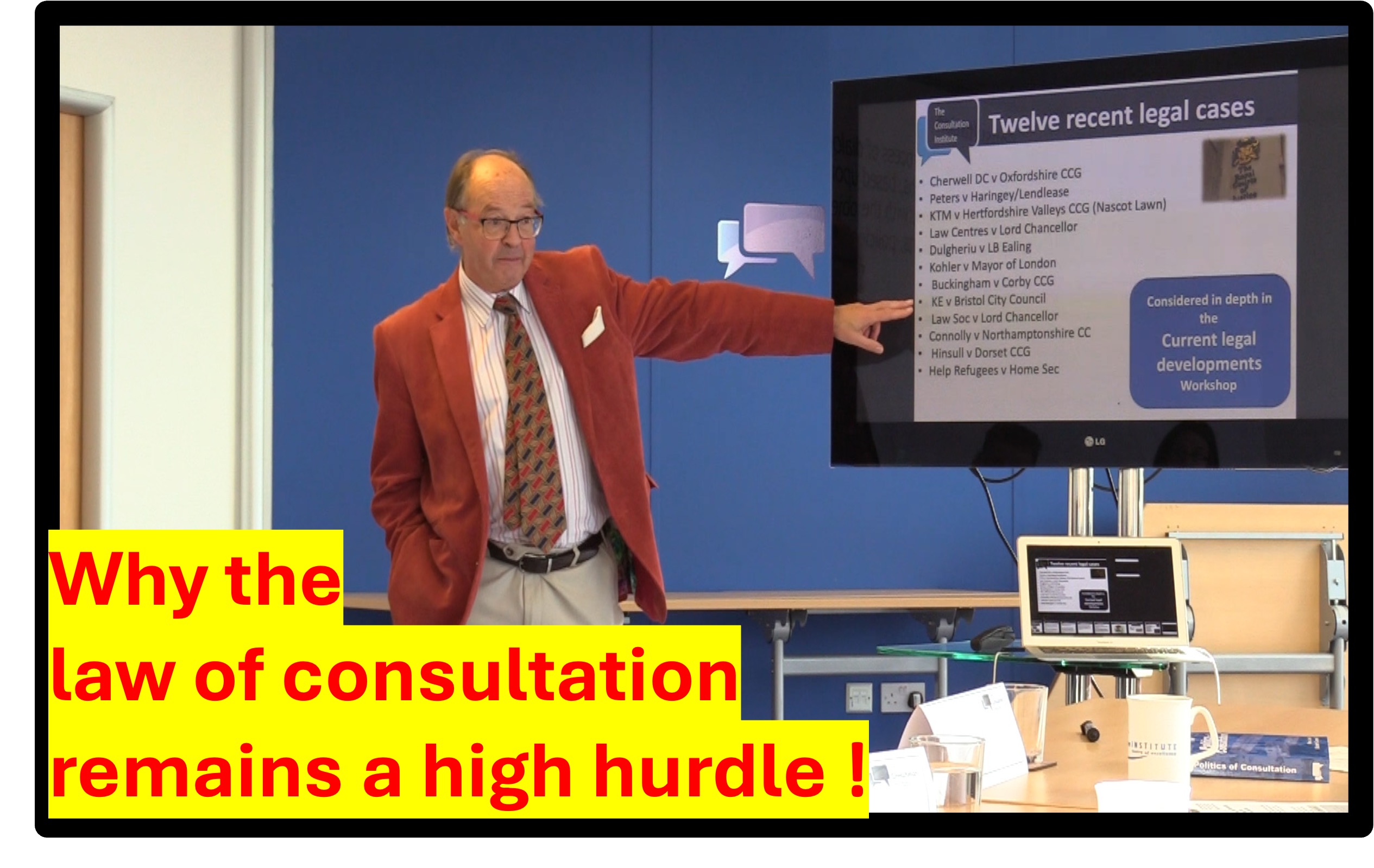
In the meantime, the Courts continue to rule on aspects of consultation law that really matter to public bodies and many other private and hybrid organisations. In July, the Court of Appeal handed down a judgment of unusual significance – given Ministers’ consistent desire not to be thwarted by procedural irregularities.
In R (BUJ) v London Borough of Bromley, the focus was on a seemingly-obscure provision in the 1981 Senior Courts Act. This says that a Judges should not quash a decision even if there had been an error of process “… if it appears .. to be highly likely (my emphasis) that the outcome for the applicant would not have been substantially different if the conduct complained of had not occurred.” So, for 45 years, Courts have had this power to overlook a failure to consult properly if it was sure it would have made no difference.
It has rarely been used. Judges are rightly terrified of straying into considering the merits of an issue – rather than just its legality. In the Bromley case, Lord Dingemans described it as ‘the forbidden territory’ and as consultation, by its very nature invites views that cannot always be foreseen, declined to say that the facts of the case met the ‘highly likely’ criterion. This meant that the Council, which had failed to consult – is now required to do so – in accordance with the Gunning Principles.
He summed up by saying:
‘Although it may be that the council will make the same decision to close the Poverest Centre after taking into account the product of the consultation exercise, I am unable to say that it is highly likely that it will do so.’
The Court of Appeal recognises that trying to second-guess a Council decision is a fool’s errand. The Council had considered nine different options before closing a learning centre for disabled people, and no matter how many experts it claimed had concurred with its preferred solution, Judges could not give it a ‘get out of jail’ card!
It is a timely reminder that those who consult must observe the rules – specifically in ways that are ‘fair’ to consultees. And it continues to be difficult to predict which judicial reviews may succeed.
On my reckoning, there have been fifteen significant judgments on the law of consultation in 2026 .. so far; nine of them claims against local authorities. Only a third of them have succeeded, but there have been several which could easily have gone the other way. The judiciary is clearly grappling with the immense challenge of applying established principles like legitimate expectation and the Gunning rules to a rapidly changing world.
In approximately chronological order, these are some of the more relevant cases I have looked at in 2026 …
- The Aspley Guise Experimental Traffic order case where Central Bedfordshire Council failed to conduct a lawful consultation and observe the necessary Public Sector Equality Duty.
- The Open Roads for Oxford case – where campaigners could not persuade the Court that the consultation questionnaire prevented opponents from expressing their views.
- Howe v Buckinghamshire CC, where the Court decided that there was no need to re-consult when one of two day-care centres threatened with closure was reprieved.
- The Care Homes in Swansea case, where, despite the consultation being legally acceptable, claimants secured a declaration that it was unlawful to approve fee increases without taking account of increased National Insurance contributions faced by the care home operators.
- The Ealing Children Centres case, which considered the Childcare Act 2006 duty to consult before closing children centres. Budgetary flexibility and the wide discretion given to local authorities led to the Council winning the case. (See GuRU Blog 130)
- The Freedom from Torture case, which found against the previous Home Secretary for disregarding the legitimate expectation of expert consultees that they be consulted on major changes to the sensitive issue of accommodation and support needs for victims of torture or human trafficking.
- The Slots at Gatwick Airport case. This was the four-day consultation done at speed to relieve airlines of their ‘use it or lose it’ obligations re the prospect of airline fuel shortages because of the Iran war. The Court ruled the consultation was lawful (See GuRU Blog 134)
There have also been three consultation cases of constitutional importance - specifically on whether or not there should have been a consultation before Government or Parliamentary action. The first was when campaigners on behalf of the displaced Chagos islanders claimed that there ought to have been a consultation before the UK Government agreed a Treaty on the sovereignty of the Islands. The Court disagreed. Then there was a claim by the Greyhound Board of Great Britain that the failure to consult prevented the Senedd from lawfully legislating to ban the sport in Wales. That was also rejected.
Finally, proposed changes to inheritance tax affecting many small farmers led to a claim that documents published 15 years ago by the Treasury and HMRC created a ‘legitimate expectation’ of a particular process before significant tax changes were made. When it went to Court as Martin v Chancellor of the Exchequer, it was very clear that there was no requirement, and the agricultural lobby is left – like others – to argue the need for consultation on political – not legal grounds.
It is impossible to predict what issues arrive in Court at any particular time; the subjects can be many and varied, and the legal issues that arise follow no discernible pattern. Not all the 2026 cases will find their way into my Autumn revision of my Law of Consultation course – but some will. Some of the existing principles have been around for years, but it is always important to appreciate how Judges apply them to contemporary situations.
Every organisation or public body that undertakes consultation needs to keep abreast of the latest judicial thinking. Despite the Cabinet Statement and its commendable wish to promote ‘modern forms of public participation’, it is worth remembering that it is ONLY consultation that gives the public legally enforceable rights that ensure that their involvement is meaningful and to guard against manipulation or dishonesty.
For that reason alone, we need an effective mechanism to guarantee that the rule of law applies when consultation happens. That’s why the law of consultation matters.
Rhion H Jones
August 2026
For more like this, and to receive the monthly Consultation Catch-up, click here
Commentaries are prepared primarily to help consultation practitioners take account of developments in the law and to guide them on situations where legal advice should be sought. They are no substitute for reading Court judgments or studying statutory provisions or associated Guidance.
Rhion Jones LL.B has monitored and written commentaries on the Law of Consultation since 2007 but does not provide legal advice. He will, however, be happy to discuss the content of this or any other commentary.
___________________________________
Note: The Westco Academy provides an opportunity for individuals to attend a version of Rhion’s course – the Law of Consultation for Public Service Professionals
Wed 14 October 2026
10am - 1:30pm at Westminster City Council 64 Victoria Street London SW1E 6QP
Price £195 + VAT Book here
Leave a Comment
I hope you enjoyed this post. If you would like to, please leave a comment below.