This is Blog No 124
My first reaction to this was “What’s taken you so long”?
Regular readers of Consultation GuRU will know that I think we need a radical re-think about consultation. Yet nowhere is it more necessary than in Whitehall.
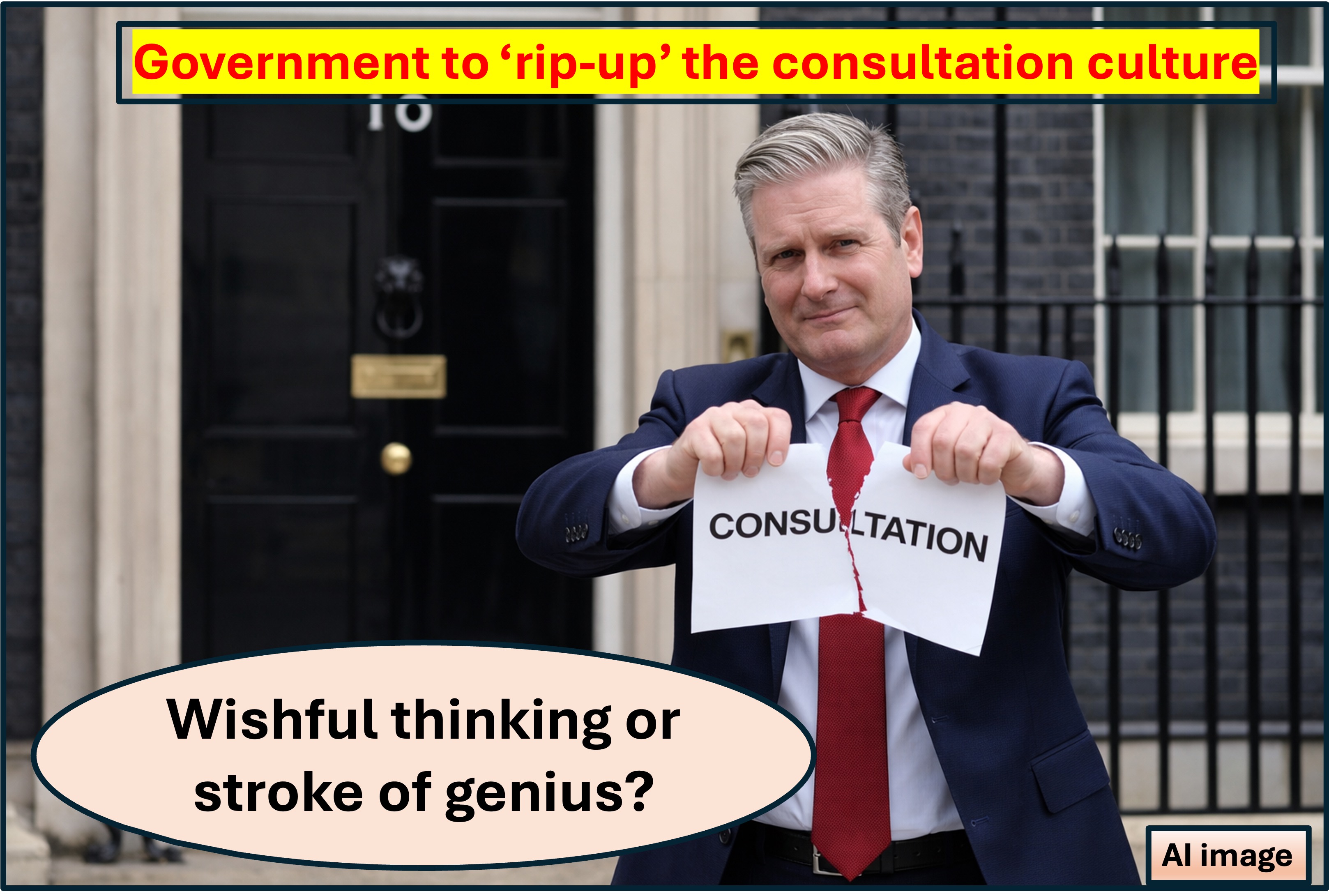
Politicians have always been deeply ambivalent about consultation. It’s one reason why Elizabeth Gammell and I wrote The Politics of Consultation almost eight years ago. When it serves their purposes, they are all for it. If it delays or inconveniences them, they will seek to avoid it! Successive Governments have allowed Ministers to play fast and loose with policymaking processes, and it is almost impossible to predict when they will, and when they will not consult.
When they do so, the standard varies from the brilliant to the abysmal. Their propensity to listen to public and stakeholder views is also unpredictable. There is a fixation about a specific style and format for consultation – even though there are now far more effective forms of public engagement! That is why I published the FOUR FUNCTIONS FRAMEWORK - and why I will argue for a more agile approach to consultation!
So, three cheers for a Government prepared to look afresh at consultation.
But it’s off to a bad start by using over-dramatic language. ‘Ripping up the consultation culture’ is PR-speak designed to please those who hate anything Government attempts to do. This may work well with some readers of the Daily Mail, but what on earth does it mean for those who take an intelligent interest in the way our democracy works?
So let’s look at the four concrete actions Ministers have announced in this Press Release, and examine the extent to which they match the hyperbole …
- End the introduction of unnecessary reporting and consultation requirements through introducing a higher bar to their inclusion in legislation.
What a good idea! Those who draft legislation have undoubtedly gilded many lilies and unnecessarily gold-plated for years. The Press Release says that they counted 131 consultation requirements in just 10 pieces of legislation But wait a minute! You are not going to de-clutter the system by promising to use consultation more sparingly when enacting NEW laws. The problem lies in the thousands (yes thousands) of legal requirements that Parliament has created over 50 years. And until someone removes them, they will remain the law of the land, and will be enforced by the Courts. So this will take years to make a difference.
- Use AI to identify existing disproportionate reporting and consultation duties that are slowing down delivery.
Another good idea – but AI is pretty irrelevant, unless you think it might be clever enough to make a judgement about the role that consultation makes to ‘slowing down delivery’. We already know that Ministers felt it was a blocker in planning, but the evidence was rather thin. Personally ,I think politicians, officials and parts of the media have found it convenient to blame consultation when other factors have actually been responsible for delays. But assuming that there are such ‘disproportionate ‘ situations, my Framework provides ample opportunities to seek faster, more agile ways of listening to the advice of well-informed stakeholders. The consequences of not engaging with them are easy to see. Faster delivery, maybe. But more unforeseen consequences and mistakes … and more ‘embarrassing U-turns!
- Take action to ensure Equalities Impact Assessments are proportionate and actually improve policy and outcomes.
I have sympathy with this also – not because they are necessarily disproportionate, but because many are totally unreadable (see below too) and do not help policymakers and consultees think through the likely implications of their proposals. Either we genuinely want to observe the principles of Equality legislation and avoid discriminating against the protected categories or we do not. And unless we oblige someone to work out the likely impact, how can anyone judge how good an idea might be. THIS is a better place to deploy AI. Scan the Impact Assessments and strip them of less meaningful verbiage – and focus on three simple questions. Who may be disadvantaged? To what extent? And What can be done to mitigate the impact?
- Replace Environmental Impact Assessments with Environmental Outcomes Reports as part of a significant step in reducing bureaucracy around new infrastructure projects.
This was going to happen anyway. Three years ago, a consultation by the Sunak Government sought to overhaul the much-criticised regime of Environmental Impact Assessments. They have become enormous piles of paper, comprehensible only by a few, and of little help to those potentially affected by major projects. Whether the projected EORs will be better is a real debate. Predicting the likely outcomes of a project or policy sounds to me even more difficult than assessing the impacts, and in contentious areas like biodiversity, air quality, energy usage and other aspects of climate-change, it’s hard to see how difficult trade-offs can be managed with honesty and transparency without this work being done. Of course, the Government may wish just to do it all in-house, ask us all to trust them to make these judgements on our behalf, and forget about involving us. Really????
Taken together, these reasonable proposals don’t exactly amount to very much – and are a million miles from ‘ripping up’ any culture! But I suppose Ministers want to be seen as aggressive cost-cutters and champions of decisive decision-making.
But then the Press Release goes on to say: “Where policy impacts a wide range of complex groups, consultations are necessary and helpful …”. I have news for the Government. Most issues fall well within this category. Just take some of the recent consultations it has launched.
- On Special Educational Needs and Diversity (SEND), where successive Government have failed to address the mismatch between legislative intentions and the funding to fulfil them.
- On Digital ID and the massive implications of various approaches to this societal problem
- On curbing access to social media for children and young people, and where there are hugely varying opinions in society, and where Governments everywhere are having to tread very carefully
We have also recently had the controversial consultation on making it more difficult for immigrants to become British citizens – called A Fairer Pathway to Settlement. And in Planning, we have had a tortuous consultation on new National Planning Policy Framework (NPPF) – something that affects millions of people and the areas in which they live.
It cannot possibly be in Keir Starmer’s interests or the Labour Party’s to make mistakes on important matters like this, and, as some of these consultations are quite good, what on earth can be gained by trashing the idea of listening to stakeholder advice?
Unless Ministers are careful they will throw out the precious ‘listening’ baby with the what they see as the bureaucratic bathwater.
There may well be better ways of undertaking Government consultations, but talking of ripping-up the culture is a bad start and unworthy of Ministers whose aim of improving decision-making is honourable and deserves support.
Stroke of Genius?
Not quite!
Rhion H Jones LL.B
For more like this, and to receive the monthly Consultation Catch-up, click here
Find the full FOUR FUNCTIONS FRAMEWORK document here
Leave a Comment
I hope you enjoyed this post. If you would like to, please leave a comment below.