This is Blog no 136
In the Burnham Government’s recent Cabinet Statement ‘Re-wiring the State’, there is this commitment:
“…to replace the current model of consultation by default with new and modern forms of public participation. This includes considering where performative statutory duties to consult can be revoked and how we can more actively bring the public into the policy-making process instead…”
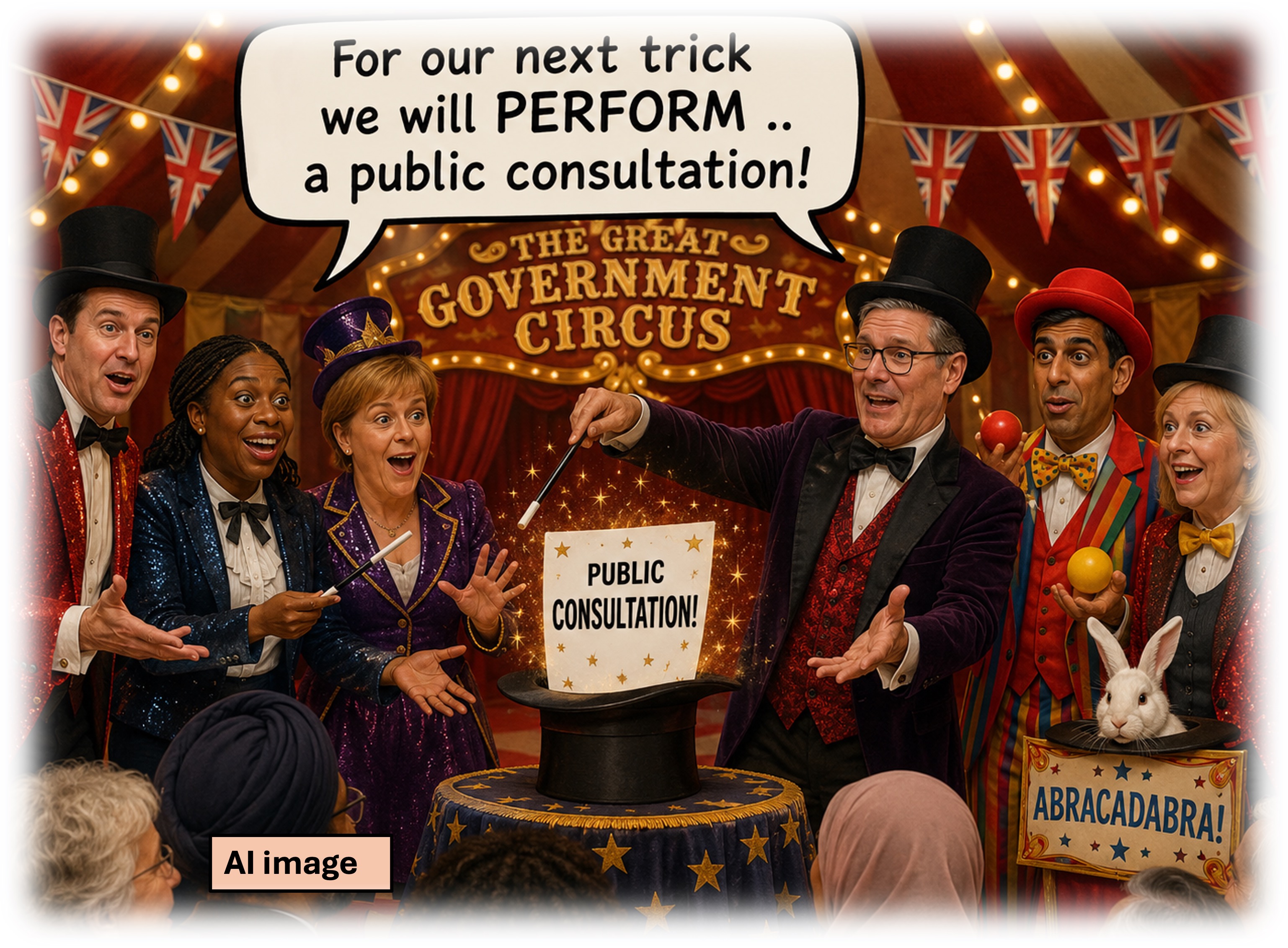
So, let’s examine the idea of ‘performative’ consultations.
- The word ‘performative’ has become fashionable, and has moved from its original usage as ‘operational’ to a pejorative suggestion that one is doing something in order to be appreciated – literally as an actor ‘performs’ for an audience. Critics of President Trump claim that much of what he says and does is just for effect, and is designed solely to make a certain impression. Similarly, there are those in the UK who complain that ‘government by press release’ is ‘performative politics’ – driven by entirely by short-term publicity and media management.
- No consultation should be ‘performative’ – i.e. going through the motions as a PR exercise, but sadly there have always been such exercises. Sometimes they have been well-intentioned. ‘Let’s ask people what they think’ can be a popular response to a difficult issue and hard decisions are usefully postponed. More cynically, decisions may have already been taken, yet politicians want to pretend that they still have an open mind. Worse still, a consultation can be used to shut down debate completely and avoid discussion of wicked issues.
- Parliament has regularly burdened new institutions, executive agencies, non-departmental public bodies (NDPs) and a large number of arms-length bodies with duties to consult in all manner of situations. Often this arises when MPs and interest groups worry about powers being given to bureaucrats with insufficient accountability, and have lobbied Parliamentarians to impose a specific obligation to consult which has been written into new laws or regulations. It has also suited our centralised civil service to have more checks and balances with which to monitor their behaviour. Are you sure you’ve properly consulted your stakeholders? can be a potent tool of subtle influence.
- I suspect this lay behind Keir Starmer’s frustration when he found that proposed changes became difficult and that the ‘levers of power’ often got mired in the bureaucracy of inter-dependent agencies that had to consult each other and a myriad stakeholders before anything was done. In short, the freedom of public bodies was hobbled by processes which seemed designed to inhibit change and/or cause delay. None of this suggests it’s wrong to consult in principle, but the statutory requirement to do so increases the risk that a proportion of these exercises will be ‘performative.’
- The Courts have not always helped. The 1985 Gunning Principles – still a sound foundation for assessing the fairness of consultations – are showing their age and are difficult to apply to many modern situations. When you have been planning a new hospital for three years and then consult the public on its location, the concept of ‘formative stage’ (Gunning One) becomes tricky. And as for having sufficient information (Gunning Two), ask those blighted by the prospect of a 100-mile parade of pylons marching through their countryside whether the ten-foot tall pile of published papers really helped them give ‘intelligent consideration’. My Blog 134 on Gatwick Airport’s four-day consultation case - recently considered the modern approach to Gunning Three, and the whole idea of ‘conscientious consideration’ (Gunning Four) is causing understandable concern as we use AI to gather and assess much of what we hear. Taken together, we have created an environment where reasonable consultees often have come to believe that the consultation was not entirely fair, and increasingly ‘performative’. “If they didn’t volunteer this information, then they are only going through the motions.” No wonder that genuine consultors become exasperated. They may have intended a thoroughly professional consultation only to find that a technical non-compliance makes everyone think it’s performative …!
There are therefore two situations:
First are consultations which are ‘performative’ because the organisation has no real intention of being influenced by its output. Or maybe will not have the capability or time to respond?
Secondly, those where perceived failures of process makes them look as if they are ‘performative’.
Both can happen because the requirement is unrealistic. In the NHS, the long-standing commitment to involve and consult on proposals for service change has always been problematic and subject to varying interpretations of ‘proportionality’. For less complex scenarios, the recent emphasis has been on what the Cabinet statement calls new and more modern forms of public participation.
But these are not problem-free. Consultation may be cumbersome, but many participative techniques also have problems – notably ‘who is in the room?’ and the dangers of manipulation. As for the aspiration of bringing the public into the policy-making process, robust management of Citizens Assemblies and their derivatives cost more and take longer than many a consultation!
None of this is to fundamentally disagree with the Cabinet’s direction of travel. We DO need to reform consultation – but it is neither feasible nor desirable to eliminate it because there ARE situations where decision-making is so much better if there has been a properly-run, legally enforceable consultation. That’s why I keep returning to the all-important question – WHY are WE consulting? My FOUR FUNCTIONS FRAMEWORK remains one of the few published alternative ways to approach this issue, and why it may be the best way to help the Cabinet realise this latest ambition.
Where to start?
Why not look at the requirement for local authorities to consult on their Budgets? This was never a statutory requirement but derived in-part from an unintended consequence of best value guidance. Local government finance has been impenetrable for generations and by the time officers have the information to pose meaningful options to a largely-confused public, there is never adequate time to act upon what it says. I have always regarded these exercises as doubtful. I wish I’d thought of using the word ‘performative’ sooner!
Here is a challenge for public engagement professionals.
Can we look at all those consultations that happen week-in, week-out and ask ourselves honestly:
Are they, in whole or in part, ‘performative’?
If so, what makes them so? Are they still needed?
Let’s kill or cure!
Rhion H Jones
August 2026
For more like this, and to receive the monthly Consultation Catch-up, click here
Leave a Comment
I hope you enjoyed this post. If you would like to, please leave a comment below.