This is Blog no 130
When the London Borough of Ealing decided to re-configure its children’s services in 2025, it sought to develop its community outreach services whilst closing many of its local children’s centres.
It was a controversial proposal!
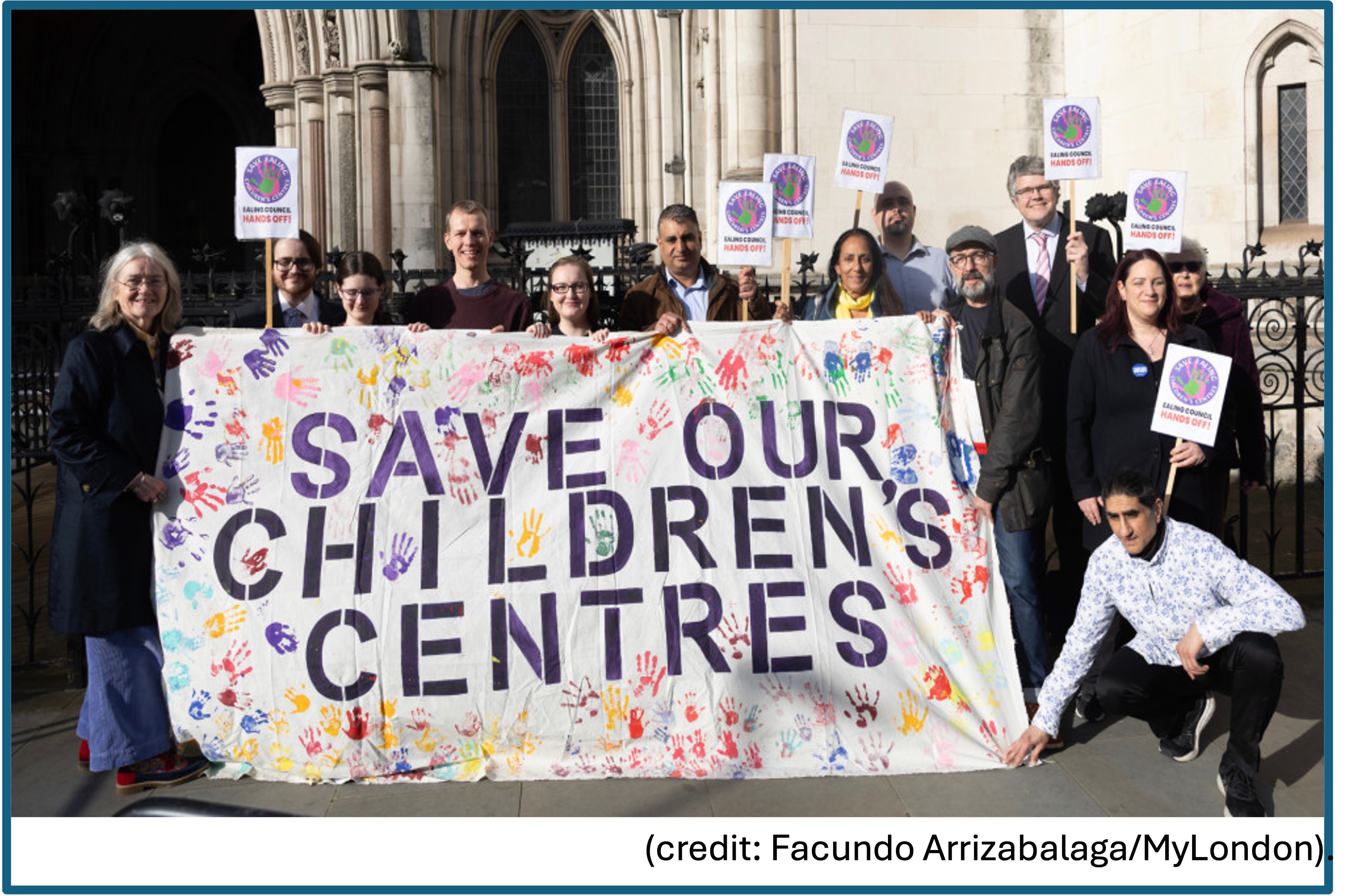
2,300 people responded to the consultation and many campaigned against the closures. Critics of the Council argued that it had already determined the outcome by agreeing to a £750k savings target, and that the consultation could not meet the requirements of the Gunning One principle – that it be undertaken whilst proposals were still at a ‘formative stage’
In R (JO ) v London Borough of Ealing, Mr Justice Kimblin rejected the claimant’s case and ruled that the consultation was lawful. The judgment will have come as a relief to the Borough, and also to many other Councils who have, for years, faced legal challenges to service changes made necessary by severe financial pressures.
Contradictory outcomes have meant that local authorities have frequently needed to walk a difficult tightrope – needing to plan in detail for aggressive budget reductions ... but without pre-determining the required public consultations. In 2018, Bristol City Council lost a somewhat similar case concerning a serious reduction in their Budget for Special Educational Needs (SEND). They had announced their intention to make £5m cuts and the High Court decided that the absence of a consultation at this point made the decision unlawful. It breached a legitimate expectation, as well as the Public Sector Equality Duty (PSED). Other cases have, however, favoured defendant Councils. What everyone seems to agree is that ‘fairness’ seems to be highly dependent upon the specific facts of each case.
This may be time-consuming (and even profitable) for lawyers, but is not especially helpful to consultation practitioners. It is therefore worth highlighting three particular aspects of the Ealing case that are worthy of some consideration:
- A Council’s wide discretion as to how to consult.
The relevant statutory requirement for consultation arose through S.5D of the 2006 Childcare Act, which obliged Councils contemplating the closure of children’s centres to ‘secure …such consultation as they think appropriate’. This obviously confers a wide discretion, subject only to relevant Guidance, but this amounted merely to a need to explain how the needs of families with children under five would be met, and a requirement to explain the reasons for any subsequent decision.
In practice, public bodies can’t just consult in any way they like, as they need to satisfy the Gunning Principles. Playing fast and loose with the information provided risks breaching Gunning Two; making inadequate arrangements to let consultees participate (through time restrictions or other constraints) means breaching Gunning Three, and a failure to ‘conscientiously’ consider the output would certainly render the exercise unlawful - per Gunning Four.
Nevertheless, the fact remains that Councils have much latitude, and it is a high bar for claimants to reach. In the Ealing case, it was argued that the Council had tried to disguise the real motivation behind the proposed changes – financial cuts. The Judge disagreed.
- The status of Cabinet budgeting decisions.
Although the Council had adopted a plan that involved target savings of £11.8m, only £750k was expected to come from the specific proposals to close children’s centres. Ealing’s ‘Medium-term Financial Strategy’ (MTFS) used the term ‘indicative savings’ and included the words:
“Some of the savings proposals will have further implications which will only emerge following detailed planning and
consultation. Where this is the case, those implications will be considered before a final decision is taken on
implementation, including whether a proposal should be amended. Where detailed proposals result in a lower
financial saving, it is the responsibility of the relevant Strategic Director to find alternative replacement savings.”
This implies a degree of flexibility far greater than evidenced in the Bristol case, and led Judge Kimblin to conclude that the process “is necessarily iterative” and “does not limit alternatives but expressly leaves open the question of alternative approaches”.
Whether officers undertaking the consultation saw it quite like that may be open to question. Organisations have a habit of insisting that decisions taken by bosses are a done-deal and not to be questioned. In this case, however, the Judge was persuaded.
- Using the output of a consultation as a way to assess its lawfulness.
One of the main aims of consultation is to equip decision-makers with a credible insight into the priorities and preferences of those who are impacted by their proposals. Over the years, when claimants have pointed to defects in the consultation itself, defendants have tried to respond by showing that such flaws had little or no effect on the ability of consultees to participate, or express their views.
In a 2011 case involving the closure of children’s cardiac surgery at the Royal Brompton hospital, the NHS consulted on four options – every one of which involved the hospital losing the capability. Protesters won their case by alleging that the decision was effectively already taken – i.e. pre-determination. But when it went to the Court of Appeal, this finding was overturned because Judges could see that the restrictive options had not, in practice, limited consultees’ ability to make the case for the Royal Brompton. In other words, the output of the consultation demonstrated that its shortcomings had not frustrated its function.
In the Ealing case, the Council had amended its proposals in the light of the consultation and had reprieved three of the children’s centres proposed for closure.
Judge Kimblin stated :
“I accept that is not the extent of change which many objectors were seeking, but it is nevertheless strong evidence
that the consultation was conducted on a genuine basis and that the outcome was not pre-determined by the MTFS.
The MTFS said that its elements were proposals for consultation and that proved to be the case as a matter of fact.”
Maybe one should not push such arguments too far. I’m uncomfortable with justifying poor process just because decision-makers appear to have taken some of the substantive responses into account or acted upon them.
In SUMMARY, the Ealing case is reminder to public bodies and local authorities that a legal challenge will put their processes under a forensic microscope, especially when they involve the withdrawal of public services. They have to be particularly careful not to appear unwilling to listen to campaigners who will be looking for less damaging solutions.
This case was brought by a parent whose words were quoted by the Judge.
He had said:
“I wish the Council could have chosen to build trust with parents and be honest by saying at the beginning that it
doesn't have enough money to run a full service and it is actively listening to ideas of what to do with a smaller
budget. It wasn't properly said in the consultation, but we know this is largely about money because they
accepted big budget cuts whilst the consultation was still in progress."
In the event, the Council had acted lawfully, and claimants could not establish that they had been misled. But the perception persisted that a straightforward cut to cherished provision was being dressed up as a service improvement and that there was a lack of candour.
Here is a lesson for all Governments – national and local. Work with people, co-produce proposals and consult on their likely impact. That’s the way to ensure lasting and more acceptable service changes.
Rhion H Jones LL.B
June 2026
For more like this, and to receive the monthly Consultation Catch-up, click here
Commentaries are prepared primarily to help consultation practitioners take account of developments in the law and to guide them on situations where legal advice should be sought. They are no substitute for reading Court judgments or studying statutory provisions or associated Guidance.
Rhion Jones LL.B has monitored and written commentaries on the Law of Consultation since 2007 but does not provide legal advice. He will, however, be happy to discuss the content of this or any other commentary.
Leave a Comment
I hope you enjoyed this post. If you would like to, please leave a comment below.