This is Blog no 140
Of course, it’s an unfair question!
For one thing, it is by no means clear how radical a change MInisters actually intend. We have all seen the press release about ‘ripping up’ the consultation culture. Then we read in Rewiring the State about the need to abandon consultation ‘by default’ and replace it by more expansive ways for the public to exert influence.
And then, a month ago, the 7th September letter on Simplification and agency pledged to “unwind the thousands of unnecessary consultation and reporting requirements that have come to litter the statute book”
For another, there are elements of mixed messages. Until the law changes, there will continue to be many consultations required by statute – and Ministers also seem willing to proceed “where it would be conspicuously unfair not to consult, or where ministers believe there is a good case for seeking external input and that the right vehicle for doing so is a formal consultation.” In my experience, that will cover rather a lot of situations!
The motive is easy to understand. They want to speed things up. They see the accumulation of ‘administrative frictions’ … “which have served to slow the work of government”. The letter wants to reduce consultation and asserts that “the default position should be that ministers reach decisions and proceed to act on them.”
To my mind, good, effective Ministers have always done this. The assumption being made in the recent Cabinet paper is that somehow consultation prevents them from taking decisions or inhibits their implementation. It would be instructive to hear of the examples Ministers have in mind!
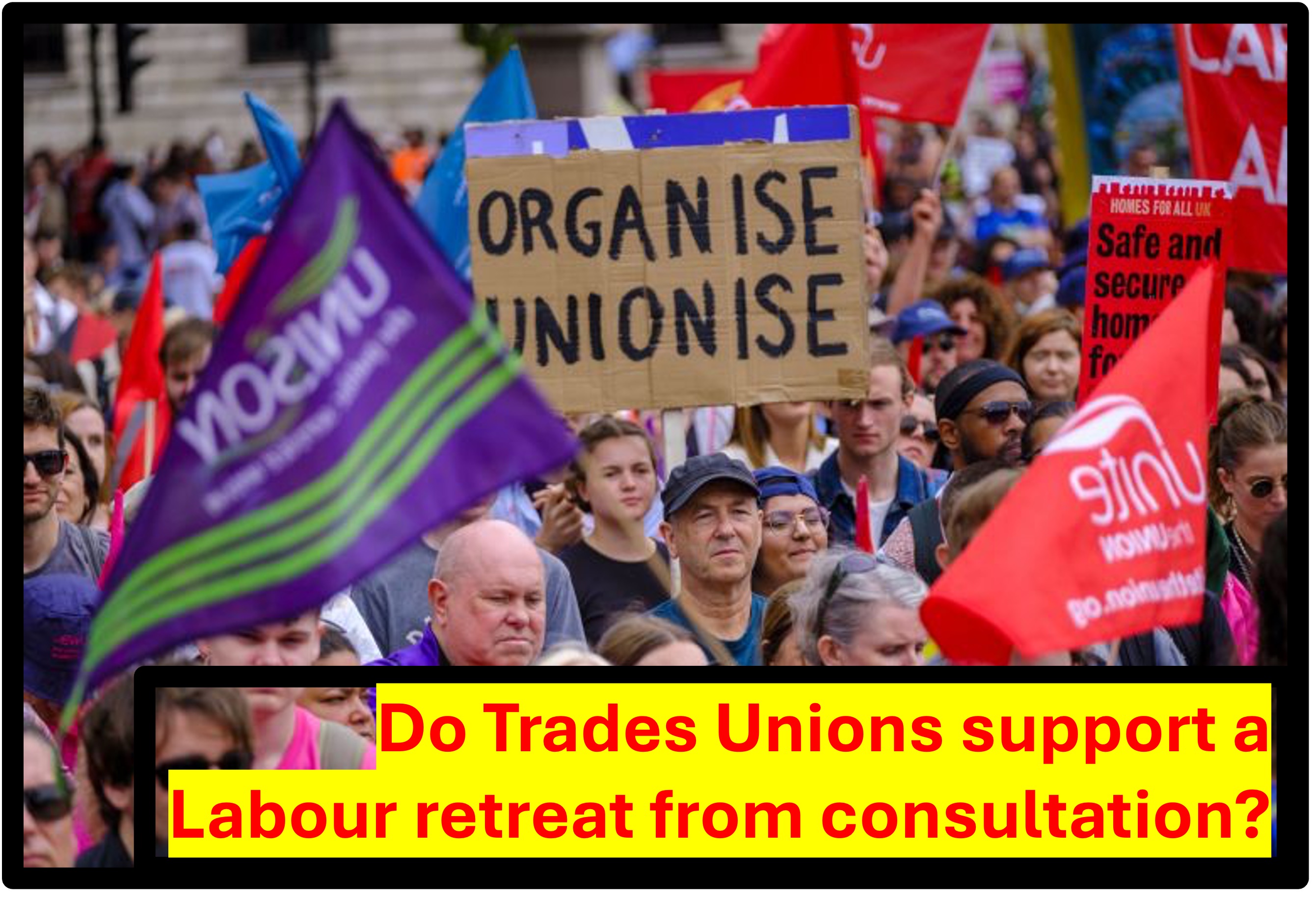
So why focus on Trades Unions?
Partly because they appear once again to have the ear of many senior figures in the Labour Party – and in Parliament. But more because students of labour history will know that the British variant of employee representation is strongly wedded to the culture of consultation. Almost 50 years ago, in 1977, the Trades Unions had their own crisis of confidence as Professor Alan Bullock prepared his era-defining Report of his Committee of Inquiry on Industrial Democracy.
It was a fascinating debate, at a time now regarded as the high-water-mark of Union power and influence. The Committee itself recommended that large companies should have employee representation at board level, and a strong role for the Unions. But this was not universally popular in the labour movement with the TUC and many Unions begging to differ. Many voices pointed to the precedent of German Unions sitting on their supervisory Boards and were worried that it would have the effect of neutering their bargaining power and campaigning role. The grassroots position is well summarised in the argument “If unions become part of management, who is left to challenge management?”
This almost-philosophical debate has echoed over the years and also appears in coalition politics. When the Liberal Democrats joined the Conservatives to form the 2010 Coalition, they effectively surrendered any ability to criticise its decisions – because they had in practice became the decision-makers. Dissenting voices within the party became frustrated and disillusioned; on subjects such as tuition fees, they felt that the leadership had abandoned their principles and compromised too much.
Today’s world is very different, and there is much more support for collective or shared decision-making. Consensus is popular but is not always achievable or workable. Being a consultee enables you to express an opinion and have influence, but the responsibility for taking decisions is normally clear and unambiguous. When it is not, there are risks. Being party to difficult decisions on ’wicked issues’ can be a tough call and makes subsequent criticism problematic.
Modern trade unionists may be more comfortable in the Board rooms and may appreciate opportunities to sit around the top tables when public policy is being determined. But they are still wary of getting too close, for fear of being too identified with decisions that don’t always work out as intended. Political power-sharing is very attractive in theory – and can be effective in some circumstances. In reality, however, blurred accountability makes experienced policy-makers far more cautious.
For trade associations, trades unions and other bodies who seek to represent particular groups or interests, Ministers’ preference for “new and more modern forms of public participation” is a little worrying. Such bodies are accustomed to serious dialogues and opportunities to comment on proposals and options; and they rely on well-established safeguards such as the Gunning principles to deter politicians from over-hasty action. Every one of the larger Trade Unions is a prolific and highly professional responder to Government consultations.
So, I wonder what they make of recent developments? Left-wing commentators have often suggested (with little real evidence) that Conservative Governments are instinctively lukewarm about consultation. They recall a time when the ‘bosses’ always knew best and saw no reason to listen to anyone else. Labour, in contrast, grew out of a 'collective voice' (See Blog 131) ethos and was thought pre-disposed to seeking out community support and the idea that stakeholders should be heard. To such people, it is puzzling that it is a Labour administration that is so keen to curb consultation!
For those most familiar with current consultations, there actually is a very strong case for major improvements to existing practice. That’s why I am beating the drum for the FOUR FUNCTIONS FRAMEWORK. But it is one thing to consult in better, more agile ways – and another to rubbish the process and announce a wholesale retreat from current forms of consultation.
I have no idea if Union leaders have yet engaged on this issue. Maybe they will soon enough. To date, though, this is a case of the dog that hasn’t barked.
Will they be comfortable with the direction of travel.?
Or can we all work together to make public and stakeholder consultation work better?
Rhion H Jones LL.B
October 2026
For more like this, and to receive the monthly Consultation Catch-up, click here
Leave a Comment
I hope you enjoyed this post. If you would like to, please leave a comment below.