This is Blog no 131
Under the Starmer administration, there is an important debate about institutional willingness to listen.
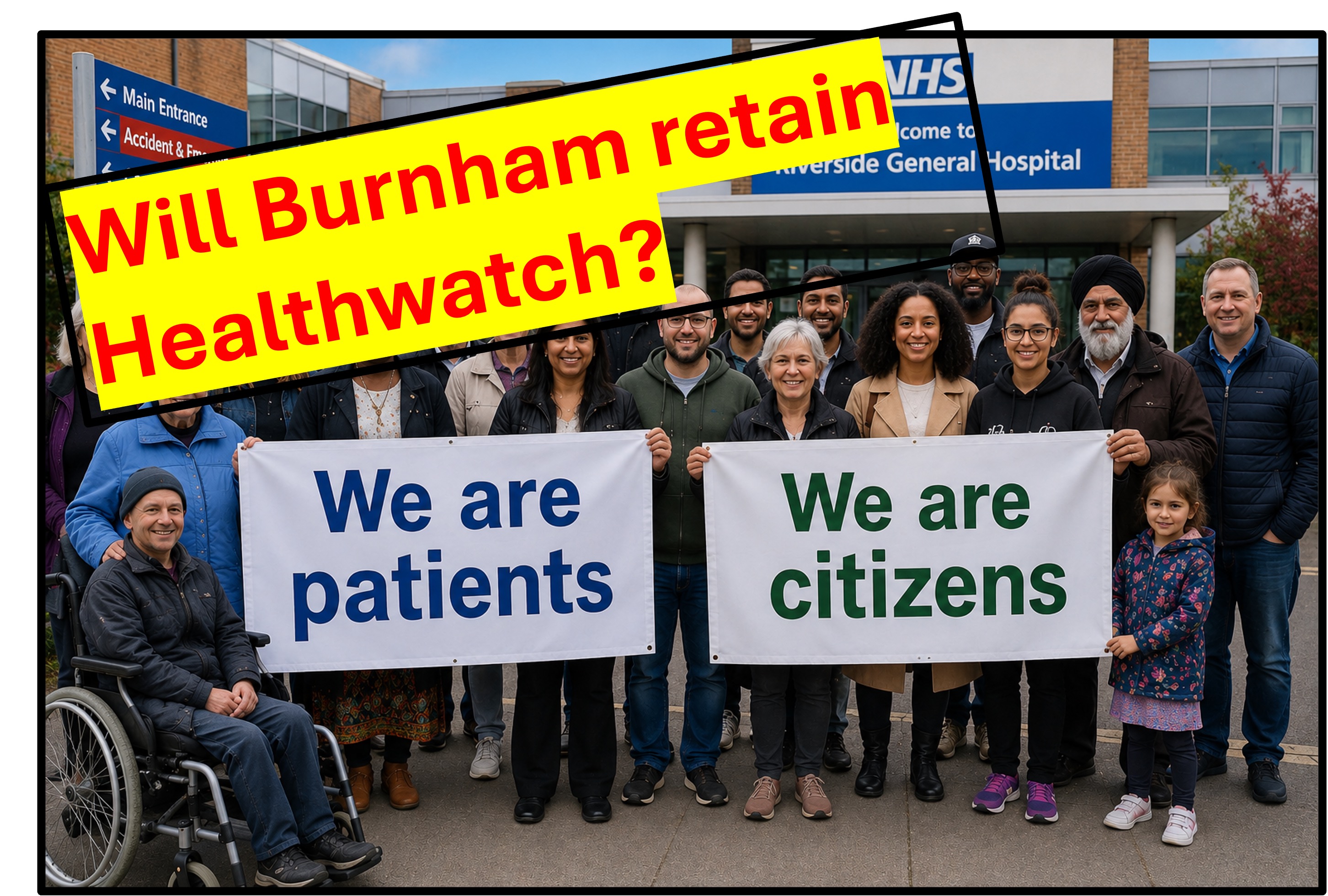
It is being played out in the Committee stage of the Health Bill where MPs are scrutinising Government plans to abolish Healthwatch in England and oblige the NHS’s 25 recently-amalgamated ICB’s (Integrated Health Boards) to take over most of its functions.
In broad terms, the arguments go like this:
- Dr Penny Dash conducted a review into the proliferation of overlapping and bureaucratic bodies found in health/wellbeing and concluded that there were too many. Of the 153 local healthwatch bodies, she argued that many have been ineffective and the current system causes confusion and duplication
- Although some Healthwatch groups provided effective research and intelligence, all they could do was submit reports and they had no direct power to secure the implementation of their recommendations
- By embedding the gathering and processing of patient feedback within the NHS management structure, it is more likely that identified issues will be addressed.
Those who have worked with Healthwatch and supporters of the current arrangements respond by saying:
- The system was set up as ‘independent’ bodies able to represent the views of local people to NHS Managers; absorbing these roles into the NHS management structure risks losing this external perspective.
- Although the NHS needs to gather and act upon individual complaints and feedback, it has not always been good at this. And it is less able to assemble broader perspectives and reach out to communities, especially those who are seldom-heard or are reluctant to approach NHS Managers. directly. This is why so many ICB’s have relied upon Healthwatch to help assemble the evidence.
- The NHS 10-year plan relies upon strategic commissioning of services being informed by patient experiences, but the NHS has just terminated the employment of hundreds of public and patient involvement specialists who were the ones with the skills and experience to undertake these tasks. In this, it is setting itself up to fail.
Underlying this debate is a key philosophical issue that made it so surprising that it was a Labour Government and Labour Members of Parliament that have sought to suppress public and patient voices. Last November, Andy Burnham as Mayor of Manchester wrote to Wes Streeting outlining his opposition to abolishing Healthwatch; he may shortly have the opportunity to reverse this mistake.
But first maybe MPs should reflect upon the history of the Labour Party, which was originally the Parliamentary arm of the trades union movement. That, of course was founded on the principle of collective action; working people standing together to prevent individual employees being discriminated against if they demanded fair wages or fair treatment. For much of the twentieth century, the Labour Party supported ‘collective bargaining’ as the way that the views of Trades Union members could be represented to managements.
Of course, times have changed. Government hostility to Unions and the trend towards ‘individualism’ weakened the movement and made it unrecognisable from its former self. But the theory of ‘collective voice’ has not been weakened. In fact, it flourishes in a world of mass consumerism and social media. Aggregating the opinions of thousands – indeed millions of individuals is the staple of much internet activity, whether it is about tourist experiences in a hotel, the performance of a product we might purchase, or our collective opinion on the local Council’s repair of potholes.
Passive gathering of public opinions is not enough. Over the last fifty years, smart organisations realised the need to provide a mechanism to discuss such insights and how best to respond to customer or service-user concerns. Some of it is labelled consultation. It is why we have Consultative committees or their equivalent in many industries. Often, they are not very good. The Water industry, for example has been obliged to sit down with the those representing the ‘collective voice’ of its consumers for years. So have airports, railway franchisees, universities and much else. When Parliament sets up new institutions, it has often found it necessary to establish a mechanism to act as checks and balances to reduce the risk of Managers making mistakes.
It didn’t always work! The Mid-Staffordshire scandal was particularly damning. Although an independent patient voice was clear and unequivocal about local failures, defensive NHS Managers ruthlessly marginalised them. It still happens. As just one example, look at the Epistemic Injustice in Healthcare (EPIC) study – currently being conducted by researchers at the universities of Nottingham, Bristol, and Birmingham. It addresses situations “when patients are dismissed as being unreliable when it comes to relaying their experiences with their own illness – with their testimonies ignored, dismissed, or explained away by the healthcare profession.” Jeremy Hunt wrote a whole book about it – “Zero” – published in 2024 and which I reviewed favourably.
The distinction between individual feedback and a collective voice was very well described to the Health Bill committee by Jacob Lant, Chief Executive of National Voices. On 16th June, he told them:
“The issue is that the system—the NHS provider, the commissioner or whoever is picking up the individual complaint—will treat that as an individual incident to look into. Healthwatch may support the individual to raise that complaint or that individual piece of feedback, but the collective learning across that is more important, and it is pulling out the themes that are consistent across multiple bits of feedback, both positive and negative, that makes the difference. We see that evidence and insight from Healthwatch making a difference in local and national policy.
Of course, one can argue that NHS Managers can also build the wider picture. But only if it is resourced to do so – and it is not. Dr Dash herself admitted as much, claiming that ICBs “all have considerable teams of people who are … speaking to different members of society and conducting … frequent events to get input and hear what people are looking for from their health and care services … Those mechanisms are already embedded within ICBs, but we need to continue to ensure that they do those as well as they can …” Shame so many were fired then …
In-house teams also tend to look at what they’ve been asked to consult upon. The power of collective voice lies not just in what it says – but in the subjects it chooses to prioritise. This ability to put things on the agenda that service providers tend to overlook is vital. Any experienced trades union official will confirm this.
They also know it is not infallible, and there is an excellent literature on its shortcomings (see especially Doug Cooper on ‘Uncovering organizational cognitive distortions’!) Ultimately, however it is the way to capture and express the view of those who have a stake in the issue. To suppress it exposes decision-makers to risks of serious mistakes – and is bad public policy.
Maybe there are still people in the Labour Party who hold this view. In these days when almost everything said or written by politicians is agonisingly choreographed by SPADs and spin-doctors, it is refreshing to read a more expansive viewpoint by a senior Cabinet Minister. Last week, the Rt Hon Steve Reed MP, Secretary of State for Housing, Communities and Local Government, published an important essay setting out his own thinking on the intellectual foundations of community power and the implications for government. It is a really interesting article, tracing the evolving approach to public services over the years and making the case for a much higher profile for the voices of local communities.
This is, in my view the gist of his argument:
“…It’s the people who use public services whose interests should dominate. Labour can break out of the old state versus market dichotomy by championing the voice of the citizen or service user, emphasising the user interest over the provider interest. That means a new way of governing so people can take more control over the services and public decisions that affect their lives. Instead of doing things to people, the state must do things with people – and that requires deliberate action to build the capacity of people and communities to participate and lead.”
Precisely!
So, why on earth did he and his colleagues want to abolish Healthwatch?
Hopefully, an Andy Burnham Government might think again.
Rhion H Jones
June 2026
Leave a Comment
I hope you enjoyed this post. If you would like to, please leave a comment below.