This is Blog No 141
There are very good reasons for taking a fresh look at the way we undertake public and stakeholder consultations in the UK. But the Government must be careful not to suggest it doesn’t want to listen.
The current position is that, following the 7th September letter from the Chancellor, there has been much speculation as to what actually will change.
In the short-term we expect Departments to scale back the number of consultations launched and to turn down requests for consultation which they might otherwise have agreed. We also expect some new Guidance which will probably focus on being more pragmatic than participative.
Less attention has been paid to the much tougher challenge of filleting out hundreds of statutory requirements to consult that Ministers would prefer to repeal. It’s worth looking at the precise words used to describe what they intend:
'Within this Parliament, we will then go further and seek to unwind the thousands of unnecessary
consultation and reporting requirements that have come to litter the statute book. We want the starting point
to be that requirements should be repealed, retained only by exception, and we will set out more detail on
this work in due course. In the immediate, departments should consider where repeals could be
accommodated in bills that they are either already progressing or bidding for in future sessions.
In principle, this type of housekeeping has much to be said for it; would that Governments might take a similar view and comb through other or obsolete aspects of previous legislation: something that AI can do so much easier these days (and maybe they should start by removing much sexist language and references that have featured in our Acts of Parliament for centuries).
I have no doubt that there are countless statutory consultation obligations that could, in theory, be culled. However, there are significant pitfalls lying in wait for anyone who tackles this challenge with more enthusiasm than political nous. This is not the time for an Elon Musk chainsaw exercise! Here are some of the issues
- Consultation requirements are rarely standalone obligations. They depend hugely on what the Courts have called the ‘statutory context’. They have to be read in the light of what the relevant Act or Regulation was trying to achieve. There have been cases where Judges have accepted that consultation was a minor or peripheral embelishment – and others where it went to the heart of Parliament’s legislative purpose. In other words – they are ALL different, and any repeal of the consultation provisions will involve consequential amendments that often involve what the consultor was meant to do with the output of the statutory exercise. Untangling this will not be easy, and hard to prioritise over more contemporary concerns.
- It will be ironic if it emerges that Ministers may seek to repeal consultation provisions specifically insisted upon by themselves or their colleagues … when in opposition! In reality, this is often how the Parliamentary discourse develops. Governments regularly enact policies, processes or even new institutions – for which Opposition Parties routinely propose extensive consultative duties. And Governments, anxious to secure the passage of their Bills – especially in a less compliant House of Lords – have accepted amendments as a way of meeting reasoned objections. Supporters of the current retreat from consultation will argue that many of these concessions were unwise and unnecessary and just the result of Parliamentary tactics. Others though will see many of these as sensible guardrails – checks and balances to ensure that new legislation did not create laws and bodies somewhat immune to scrutiny. When next in Opposition, Mr Healey and his friends might wish to amend a future Government’s Bills in much the same way!
- Most of the statutory requirements to consult are deliberately designed to ensure that certain interests are protected by the ‘right to influence’. So, hundreds of charities, industry associations, trades unions, local authorities and other ‘communities of interest’ have effectively been told: “We know we need your input – and that’s why we are putting into legislation that (such and such) won’t happen until we have formally listened to you and heard what you have to say about our proposals.” In each case, repealing the requirement will mean depriving such groups and associations of the rights conferred upon by statute. In effect, saying “We will not be consulting you from now on.” Don’t expect them to feel particularly happy!
- The Government, however, may feel it has an answer. It will say there is nothing to worry because consultation is often pretty poorly done (…it will be right there…!) and they now have better ways of doing it. Ministers envisage: “Involving a wider range of people in shaping our thinking earlier and more directly – with ministers and officials leading engagement in ways that reflect the issue at hand, and which help to build back public trust in government.”
Indeed, these commitments DO sound reassuring, and along with what, in Rewiring the State, were called ‘new and modern forms of public participation.’ Many of these, including many forms of co-production are highly effective. But these promises will not be binding. Remove the statutory requirement and we are entirely dependent upon the discretion of Ministers and subject to their whims and political calculations. Not only that. If you replace 'consultation' – with legally-enforceable rules and standards (eg the Gunning Principles) with looser forms of 'engagement' which have no enforcement whatever, every potential consultee loses their right to a fair process.
No doubt there will be ways to overcome some of these problems. Personally, I would favour an independent body – maybe call it an Office of Public Engagement (akin to the Office of Budget Responsibility, but safeguarding the integrity of public dialogue rather than public money! See Blog 125.) Conceivably, one could pass an Act of Parliament that says that in respect of these (many hundreds of) statutory consultation requirements, the new body would decide how much consultation was necessary and how it should be conducted. I’m not sure I’d hold my breath on that one …
Too drastic a retreat from consultation may also give Members of Parliament some concerns. When constituents approach them with strong/detailed views on a current controversy, it is both convenient and appropriate to refer them to the relevant statutory consultation. If such exercises no longer happen, with Ministers and officials instead relying on confidential dialogues with selected stakeholders, imagine the MP having to grapple with constituents’ arguments and having to promise to promote them to the relevant Government department! And often with enthusiastic campaigners on opposite sides of emotive arguments. When Parliamentarians realise the implications of a system less willing to consult, I foresee some serious reservations emerging.
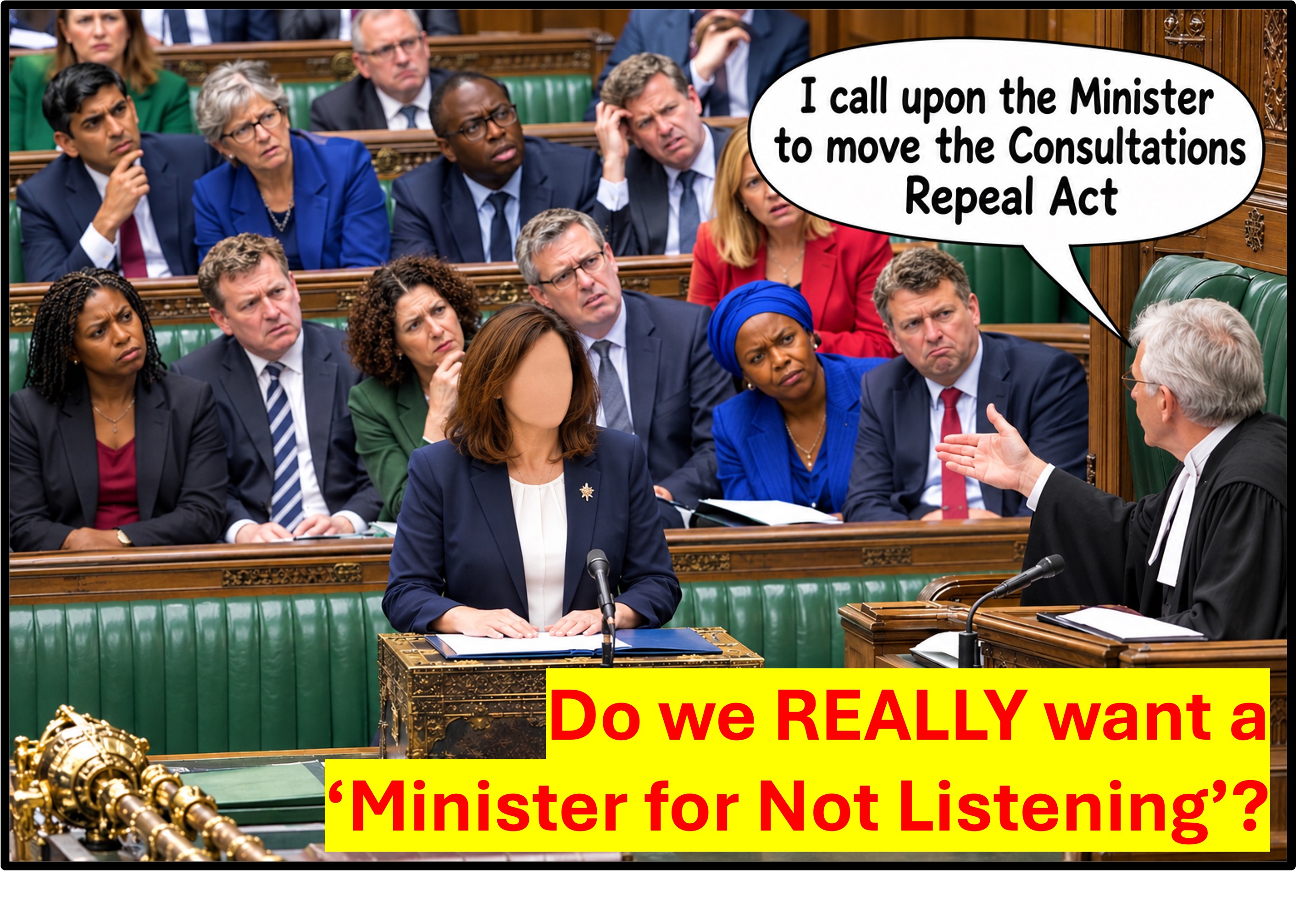
Whatever politicians and officials now consider, they should be aware that there will be widespread opposition to some – but clearly not all – proposed repeals. Who will be given the unenviable task of piloting these repeals through Parliament? The idea that individual Cabinet Ministers fight each and every battle in respect of provisions in legislation their particular departments ‘own’ is something dreamt up by someone who knows the theory – but doesn’t understand politics.
As with other unpopular programmes, someone will have to lead on it.
Does Andy Burnham really want a Minister for Not Listening ?
Rhion Jones
October 2026
For more like this, and to receive the monthly Consultation Catch-up, click here
Leave a Comment
I hope you enjoyed this post. If you would like to, please leave a comment below.