This is Blog No 139
There is no longer any doubt. Artificial intelligence can transform our understanding of what stakeholders tell us. And it provides a new twist for that recurring issue – ‘Who is in the room?’
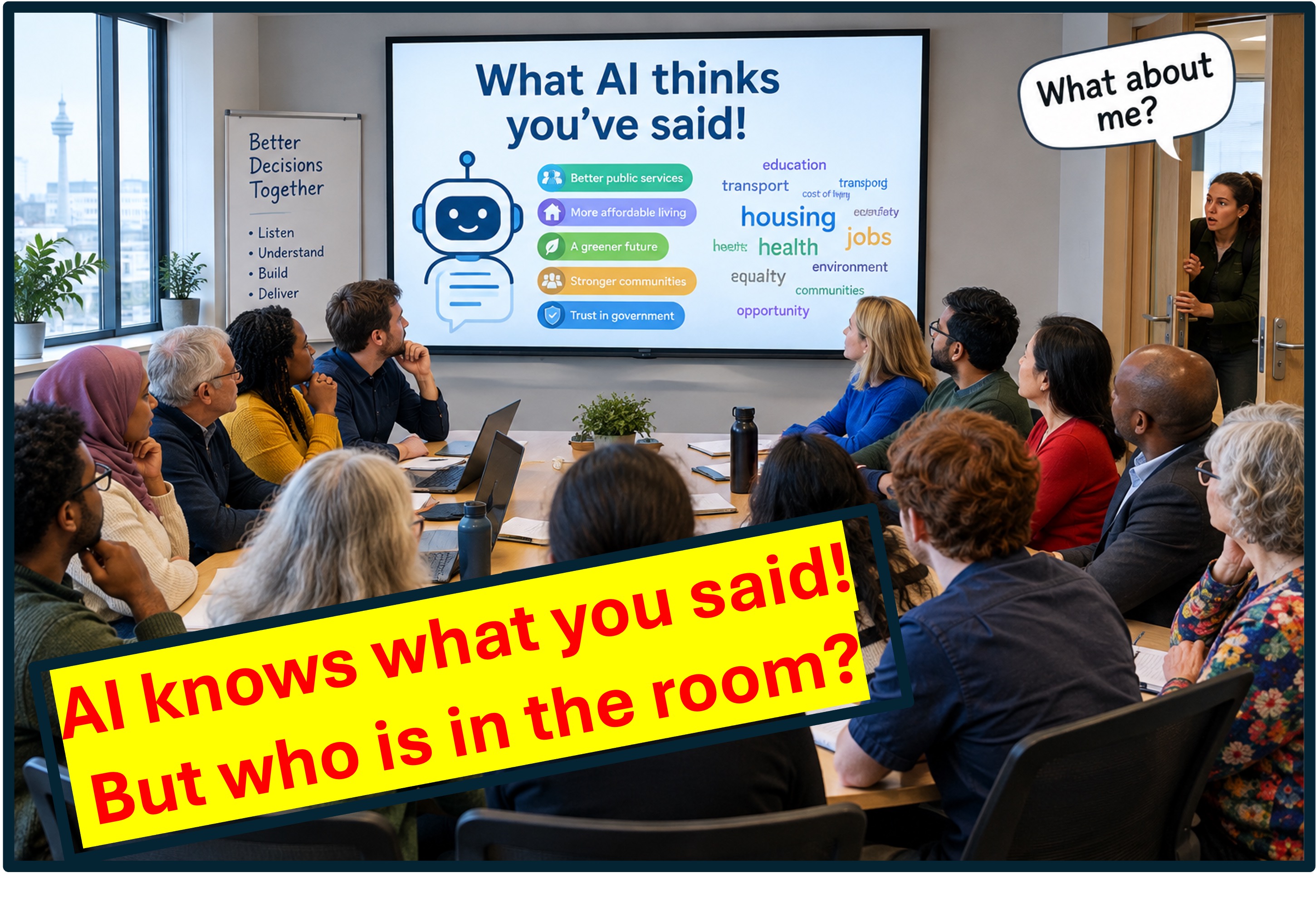
I have recently been looking at a European product called Dembrane – one of a growing range of new tools that can revolutionise the way we synthesise the complex, multi-factoral conversations that take place in serious consultations. Go Vocal is probably the best-known UK offering but there are many others like Pol.is, Remesh and Cortico – all of which can help analyse consultee views and help identify consensus.
What I found interesting about Dembrane is that it enables participants to comment upon and discuss what AI had concluded about their initial conversations. In brief, those involved scan a QR code, use their own phones to record conversations and talk in small groups. Dembrane transcribes the conversations, identifies themes and cross-currents in the room, and can produce an analysis while the participants are still present. Those participants can then check, challenge and refine the AI's interpretation of what they have said. The Company says its aim is "making sense together".
The Netherlands-based start-up claims almost 3,000 projects, about 20,000 ‘conversations’ and about 6,000 recorded hours of dialogue in its two years, working with cities like Amsterdam, Vienna and Den Bosch. It wants to work with Governments, healthcare organisations, housing organisations and NGOs, and has supported a citizens' assembly in Luxembourg and peacebuilding initiatives in Northern Ireland.
Despite this, it is clear that the Company – and its competitors - are in the early days of what is undoubtedly a fascinating journey which addresses many of the traditional limitations of deliberative processes. How often have those facilitating community or stakeholder events struggled to interpret what people are saying – or, more challenging, what they mean – or what they think? Applications like this will add a lot of value to the deliberative conversations that increasingly form the backbone of effective consultation.
So, what’s the catch?
Just the long-standing issue that conclusions can only reflect the views of those who have engaged in the exercise. A better, more accurate analysis of an unrepresentative group is still an analysis of an unrepresentative group. AI can reduce the risk that we misunderstand what participants have said. But it cannot retrospectively make those participants more representative of everybody affected by the decision.
This is not a critique of Dembrane or any other similar product. It is merely a distinction between a technology used to support participation and the methodology used to determine who participates. And it is here where some of the most pertinent debates are now happening.
For some time, Wyn Evans of Shared Voice has been urging me to acknowledge that too many planning consultations are dominated by a small cross-section of personally-affected residents whose (admittedly-legitimate) views drown out any voices that may be more representative of the community as a whole. In other words, that a vocal minority has more influence than the silent majority. (To which, the traditional response was – “if they are silent, how do we know they are a majority…?)
The criticism extends well beyond planning. Organisations are often said to be institutionally predisposed to hear particular voices. Even government departments. So, politicians and the media have often been wary of Ministries where particular industries or professions have used well-oiled lobbying channels to become especially close to their sponsoring Government departments. Ditto with Regulators with OfWAT’s relationship with the Water industry cited as a favourite case study.
What therefore is the state of play on deciding who should become involved?
Advocates of Citizens Assemblies and related processes are strong supporters of sortition methods, and there is no doubt that having a precise stratified sample ensures that participants are ‘representative’ of whatever population whose views we need to understand. This sounds foolproof except that it is almost impossible to capture every nuance and represent every thought or interests in a diverse community. Experienced consultors have often found one stakeholder’s insight sufficient to swing an argument – if provided with the opportunity to be heard!
But for many dialogues, the cost and overheads of comprehensive sortition make it less feasible. We rely on deliberative events and their modern counterparts because we cost-effectively learn as much if not more from small groups, briefed and informed impartially (not always easy) and helped to express opinions which eventual decision-makers can absorb, and hopefully act upon. All this is great, but its value depends, to my mind upon the function for which the exercise is being performed, and whether a limited ‘closed’ sample of people whose views we can clearly analyse better is appropriate.
Hence my promoting the FOUR FUNCTIONS FRAMEWORK. Those agenda-setting ‘where do we want to go’ type exercises – which I call NAVIGATION – might be extremely suitable for these deliberative methods. The search for options and assessing their potential impact in my EXPLORATION category may also lend themselves to participants using these AI-assisted technologies. I have rather more doubts about tough choices and the kind of decision-making which is influenced by many factors, not all of which are easily identifiable! Those DETERMINATION scenarios call for a process that enables stakeholders with highly-specific interests to become involved. Indeed it is essential they do so.
Ultimately, however, it is often the political context that matters. Do those initiating the dialogue feel they need a breadth of opinion and the involvement of large numbers of people? Or is it more important to probe the depth of consultee thinking and the values and concerns that drive them?
One man who has to reflect on this right now is Wes Streeting. Earlier in the month, he talked about national defence and resilience. He went on to say “We need a wider national conversation. The Government are very happy to lead that, and we will, but it needs to involve everyone: Government, business, civil society and all of us as citizens.” I assume this is all meant to be consistent with the 7th September letter on Simplification and Agency – which speaks of ‘involving a wider range of people in shaping our thinking earlier and more directly.’
For the Defence Secretary, other Ministers, civil servants, NHS Managers, Council leaders and the countless others who currently consult, these are important words - and may herald a sea-change in official attitudes towards public and stakeholder involvement. The technology innovations that fascinate us happen to have come at a time when there is growing uncertainty as to when and how they might be used for best effect. There is a need to watch this space.
We live in interesting times!
Rhion H Jones LL.B
September 2026
For more like this, and to receive the monthly Consultation Catch-up, click here
Leave a Comment
I hope you enjoyed this post. If you would like to, please leave a comment below.