This is Blog no 125
Any attempt to improve the machinery of Government should be welcome.
If Lord Hermer and Nick Thomas-Symonds have been given the task of addressing aspects of the ‘consultation culture’, let’s wish them well.
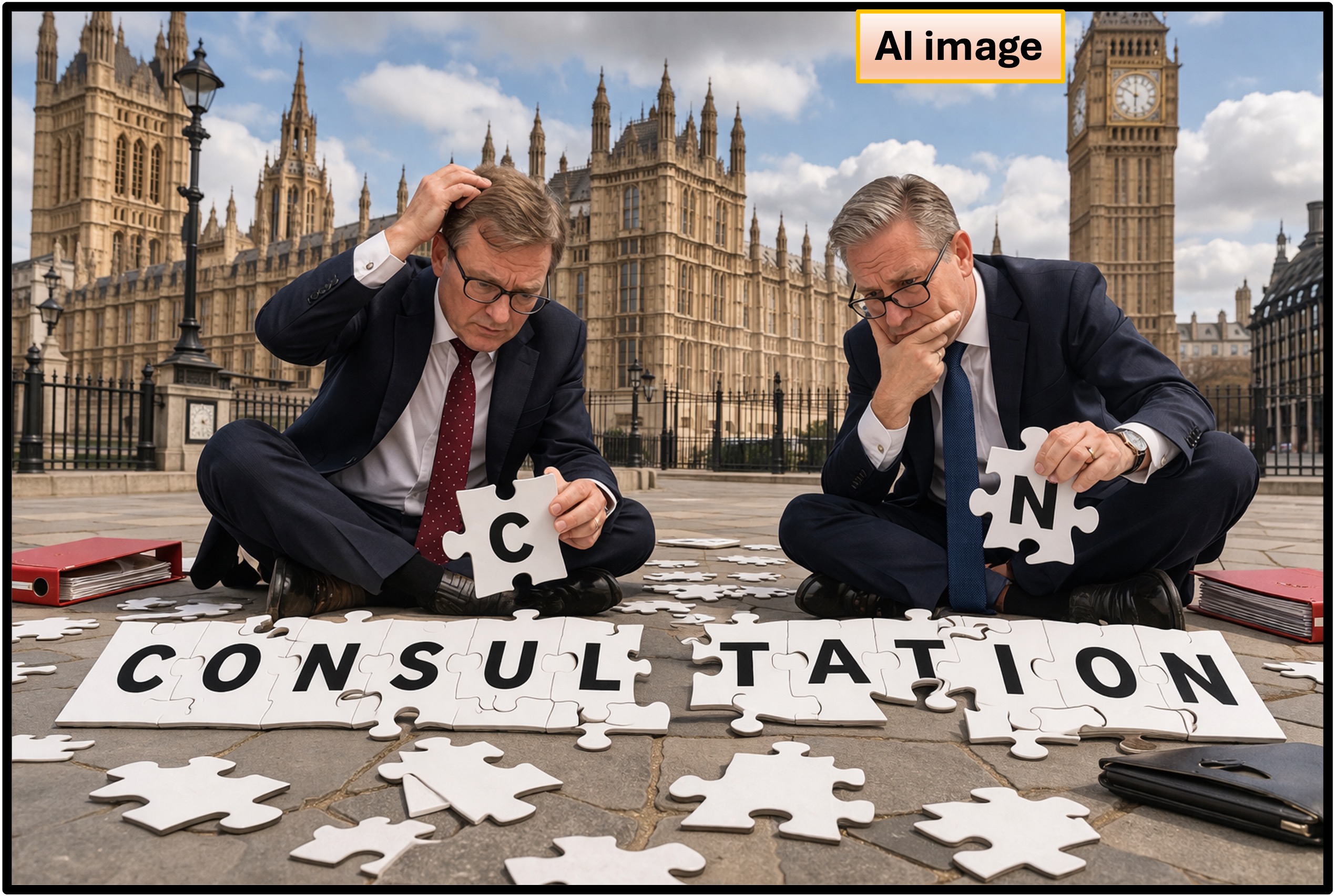
Shame it was labelled as a ‘ripping-up’ exercise, for, as I wrote in Blog 124, the substance of their proposals barely justified such language. And the Attorney General’s article in the House Magazine on 26 March (We cannot let the State be slowed down by its own procedures) was much more sensible.
Therefore, in a genuine attempt to be helpful, let’s identify the problems, and suggest some answers. But first, some basic principles.
- Being consultative – and willing to listen to advice is GOOD, not bad!
- It encourages organisations to identify who may be impacted by their decisions, and to what extent. Then it obliges decision-makers to consider consultee views before finally deciding.
- In a participative age, there are many more ways to engage people – and there are times when you share (or completely delegate) the decision-making to them. Such wider involvement can be very successful.
- Consultation principles are well-established, legally enforceable in some circumstances and form a clear blueprint for best practice.
So, what goes wrong and what problem is the Government trying to fix?
- For decades, Parliament has passed legislation obliging Government departments, executive agencies, non-departmental public bodies, local authorities and others (eg NHS) to consult – often for excellent reasons, but sometimes unnecessarily. This can often frustrate Ministers who may not have expected their intentions to be slowed down or affected by these statutory processes.
- In the policy-making process, there is (and has been for years) complete confusion as to when there should, and when there should not be a consultation. It is frequently at the whim of Ministers and their political judgement as to whether it would be helpful or not. When consultation is denied, legal challenges based upon the common law doctrine of legitimate expectation have regularly succeeded.
- When there is internal disagreement, where public or stakeholder opinion is divided, or where officials have doubts, a consultation is a favourite way to resolve the situation – but causes delay – typically six months or more. Hence the focus on accelerating slow planning processes for infrastructure projects and large-scale housing schemes.
- The quality of consultation exercises varies enormously, and, in part, this leads to legal challenges based upon inadequate consultation – usually that it failed to comply with the Gunning Principles, or poor impact assessments.
- Even when Ministers consult, they seldom get the credit for it because of confusion over the extent to which their proposals are open to influence. Levels of trust are so low that consultees believe issues to be pre-determined even when they are not. Once a consultation has resulted in significant changes to published proposals, Ministers – observing the precautionary principle - are often advised that it would be safer to repeat the exercise. Re-consultation again cause delay, cost and uncertainty.
- Because of these and other known issues, Government departments and others have become hesitant and defensive, leading to over-engineered consultations (especially with over-complex impact assessments) – designed in the hope of avoiding judicial reviews, or disguised as ‘engagement’ exercises or other workarounds that are frequently less effective and equally prone to challenge.
No-one can fix all these issues at once, but this is what I would recommend:
- Control the quantity and quality of formal Government consultations. Replace (or supplement) the use of the Gov.uk website with an effective official directory of formal consultations, providing sufficient information on current, past and forthcoming consultations and enabling one-click routes to find the output and outcomes of each completed exercise. (Note: The Consultation Institute some years ago undertook the demanding work of specifying all the required data definitions for a comprehensive database when the House of Commons Library was a potential client! Please let's use it!)
This single action would help the Government identify problem areas and prioritise solutions. At present,
I suspect it only has a vague idea of the actual number, nature and current status of its consultations.
- Stop every Government department and every policy hub doing their own thing and listening only to in-house departmental legal advice. Whilst it is important to let ‘domain experts’ be closely involved in developing a consultation, many are officials without relatively little previous experience of this kind of engagement. Consultation has become a specialist skill requiring extensive experience of stakeholder identification/mapping, options assessment, dialogue methods and, increasingly the use of AI as part of analysis and interpretation. Practitioners need high-quality training. A centralised team working from the Cabinet Office should co-ordinate the programme of consultations, observe the right standards, encourage the timid and rein in the over-zealous.
- Replace the current Consultation Principles with better Guidance. Upon election, the Coalition Government foolishly scrapped the excellent 2008 set of proportionate Guidance developed under the previous Labour administration and substituted a far less effective and less precise set of principles which has enabled consultations to be less consistent and more open to challenge.
But times have changed and we need to remove the focus from the classic 12-week ‘proposals or options
for comment’ model with far more agile – and quicker forms of consultation. This would be best done by
placing the emphasis on the PURPOSE of a consultation. The FOUR FUNCTIONS FRAMEWORK I have
proposed distinguishes between four very different functions:
- NAVIGATION – What are our objectives? Where are we trying to go?
- EXPLORATION – What are the various ways we could get there? What are the ideas or options?
- DETERMINATION – The choices we have to make between alternative actions
- IMPLEMENTATION – How can we give effect to decisions or projects.
The nature of the consultation and the standards by which they should be judged will vary according the
function being performed. (To read the full Background document, click here)
If this new Guidance obliged every Minister and every civil servant to think seriously about the reason for a
consultation – and use this framework, it would be possible to use quicker, more agile ways to hear
stakeholder views and reduce the number of expensive, time-consuming formal consultations.
Ideally, I would go further and establish an independent Office of Public Engagement, broadly on the model of the Office of Budget Responsibility. This would sign off key consultations and go some way to insulate Ministers from the perennial allegations that they are just going through the motions. Also I would require all major consultations to be debated in Parliament, so that elected MPs could have a say – as well as those who participated in the exercise.
Perhaps that is going a bit far and we do not yet know how ambitious Lord Hamer and Nick Thomas-Symonds are to improve this aspect of governance. Let us hope that this is more than a neat initiative to grab a headline or two and signal their displeasure at being bogged down in bureaucracy.
There IS a case to answer.
Consultation needs a radical re-think, and the opportunity to make things better must not be squandered.
Rhion H Jones LL.B
April 2026
For more like this, and to receive the monthly Consultation Catch-up, click here
Leave a Comment
I hope you enjoyed this post. If you would like to, please leave a comment below.