This is Blog no 142
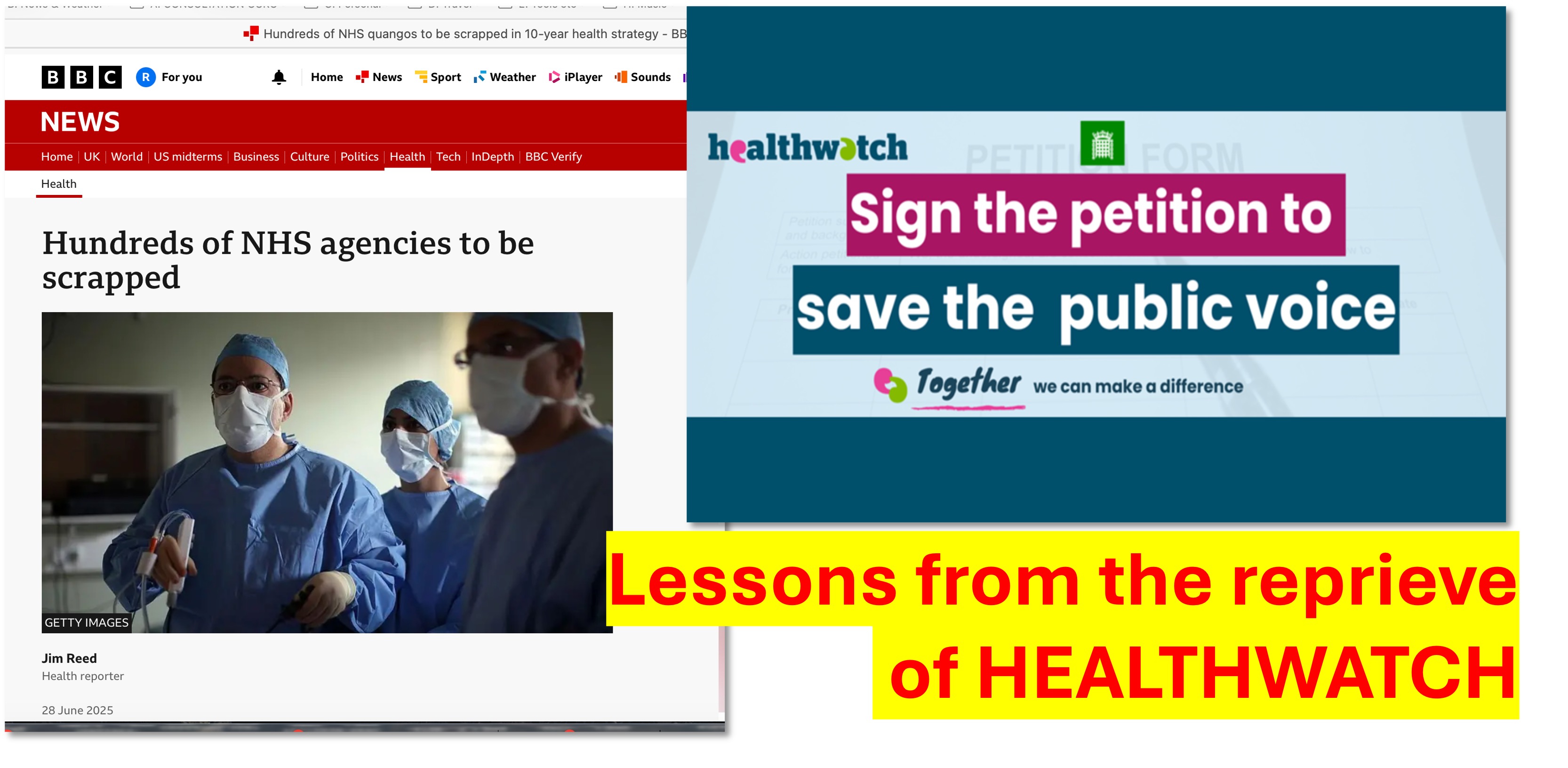
In the heartfelt relief that Healthwatch will not be abolished after all, it may be tempting to overlook some rather important lessons.
We need to understand the forces that led to the unexpected announcement of Healthwatch’s demise. And consider what the recent turn of events can teach us about the priorities that lie ahead for national policy-making and for local communities
Lesson One Collective voices are uncomfortable for technocratic management.
The impetus to abolish Healthwatch and its three predecessors comes not from politicians but from Managers who view them as a nuisance, getting in the way of speedy implementation of their decisions. They accept that there should be a measure of scrutiny, but do not like formal machinery with statutory powers to be heard. Their instinctive preference is for complaints and criticisms to be collated, analysed and responded to in-house, by-passing any need to be transmitted by an independent body. They would argue that AI will be much better at filtering the issues, estimating impacts, recommending solutions and priorities than any external body might be. The welcome reprieve of Healthwatch won’t of itself change the long-term cultural suspicion of Managers in hierarchical command-and-control cultures like the NHS.
Lesson Two Organisations seeking to be representative of communities are always vulnerable to criticism. Local Healthwatch groups have many critics who argue that they are a minority sport for unrepresentative activist bystanders whose claims to speak on behalf of complex, diverse populations can frequently be contested. Many have struggled with the profile of their members, frequently over-representing white middle-class elderly retirees and often failing to include young people, minority ethnic and disadvantaged groups. Such caricatures are unfair and probably obsolete, but the genuine difficulties of ‘representativeness’ remain, and need resources on the ground to address. Too many have been denied sufficient funding.
Lesson Three “Use it or Lose it”
It has been seriously gratifying in recent months to see so many at local and national levels rallying to the cause and lobbying to reverse Wes Streeting’s mistaken decision. Is it not an example of the old adage that we often don’t value some things until they are removed – or there is a threat to take them away? Someone in DHSC presumably made a calculation that objections to the abolition would be confined to those immediately affected and a range of ‘usual suspects’. They underestimated the amount of local support many Healthwatch groups enjoyed. But maybe the problem here was that this support was largely silent - poorly reflected in social media and rarely receiving adequate coverage in the broadcast media. If we want to keep valuable sources of influence – we must use them better. We almost lost Healthwatch!
Lesson Four How not to build trust in Government.
The death and resurrection of Healthwatch may well become a mini case-study in how Keir Starmer’s Labour administration squandered the trust of some of its own people. A party that likes to champion its role as fighting for the rights of ordinary people and the underprivileged came close to closing one of the few effective voices that sought to influence the massive bureaucracy of the NHS. The rationale was flawed from the outset and anyone who knew the subject found the idea that there was no need for an independent collective voice preposterous. Starmer and Streeting seemed to have been seduced by the happy thought of scrapping hundreds of quangos, and strangely unconcerned that shutting down such channels of feedback would undermine public confidence. Labour’s new PM has sharper political antennae and opposed the abolition. Shame the U-turn gave hundreds of diligent staff 16 months of personal anguish and distress whilst fearful that they were about to lose their jobs!
But there is a further lesson – and a warning for Ministers who are at risk of repeating this mistake on a wider scale and well beyond the NHS.
In the wake of its Rewiring the State paper in July and the 7th September Simplification and Agency letter, the Government is committed to reducing the number of consultations. This is not necessarily a bad thing, and I have personally supported radical reform of the way we consult. But its plan to repeal hundreds of existing statutory rights to consult is far more contentious because it removes from thousands of stakeholder organisations legally enforceable rights to influence that they may fight to retain.
In the same way that the threatened abolition of Healthwatch alienated many of its own supporters, the Labour Government is in danger of uniting charities, trades unions, industry associations, local authorities and consumer groups in an unholy alliance to oppose a Government that will appear not to want to listen!
My Blog 141 outlines the arguments in detail and used the provocative headline “Do we REALLY want a ‘Minister for Not Listening’?
Congratulations to the Rt Hon Yvette Cooper.
For the time being, at any rate, she at least will not carry that title!
Rhion Jones LL.B
October 2026
For more like this, and to receive the monthly Consultation Catch-up, click here
Leave a Comment
I hope you enjoyed this post. If you would like to, please leave a comment below.