This is Blog 133
All Governments are ambivalent about public consultation.
On the one hand, they all are keen to be seen to be listening – particularly to well-informed stakeholders.
On the other hand, they want to get on with it, and hate the time taken by meaningful engagement and consultation.
But Labour has always faced a more pressing dilemma.
It is not just because consultation can be viewed by some as a leftist concept. Neither is it because Labour Ministers are more aggressive in seeking to accelerate policy implementation. Both these have a grain of truth to them, but recent history suggests it is more about the party’s problem with public expectations – and the contrast with the expectations of its own membership.
Over the years, right-wing parties have been generally viewed as more autocratic and less amenable to external influence. Indeed, the much-vaunted success of the British conservative party has often been attributed to a ruthless streak. Only in recent years were its members able to vote for its Leader, and many would view it as an unhappy experience.
The Labour movement, in contrast, always considered itself as more representative of its base. This is mostly cultural - and maybe dates from the old trope that young people used to join the Conservative party to meet socially at the Young Conservatives, and their equivalents in the Labour Party would meet in pubs to have intemperate arguments about policy (and only ever agree that it was all the fault of the media …!)
These old stereotypes are long out-of-date, but it still makes it difficult for Labour Ministers to convince its grassroots supporters that something planned and agreed upon in a Manifesto should go to a wider consultation. The view would have been that the party has decided – and there’s no reason for further dither and delay. Just do it!
It was the genius of Morgan McSweeney that enabled Labour to win the election handsomely with relatively modest proposals dressed up as a promise for change where the whole was presented as far greater than the sum of its parts. Only when confronted with the tough choices on implementing its ideas did Ministers really grapple with the need for consultation.
To his credit, Sir Keir Starmer’s can point to a vast number of meaningful consultations on employment rights, on planning laws and a whole range of significant public policy issues. They include:
- Heathrow expansion (National Policy statement)
- A regulatory framework for automated vehicles
- Changes to the process for modernising UK airspace
- Public safety (Martyn’s law)
- The use of Facial Recognition technology
- Decoupling gas prices from UK energy costs
- Changes to Immigration policy including ‘earned settlement’ proposals
- The Timms Review of Personal Independence Payments
- Tobacco and Vapes restrictions
- Re-selling of tickets
- Local government reorganisation – many separate consultations on local proposals
And several hundred others … Two particularly notable consultations include that on social media use by young people and on proposals for Special Educational Needs and Disability (SEND)
No-one can therefore accuse the Starmer Government of a failure to consult.
Most of these have been thoroughly professional, honest exercises in listening undertaken by conscientious officials ticking the relevant boxes. Okay; they still rely too much on jargon-infested documents and there is not enough genuine engagement or co-production. But overall, they are helpful in shaping policy and influencing legislation.
More questionable has been the real willingness to listen.
- The Department of Health conducted a massive, expensive national conversation on ‘A Health Service Fit for the Future’ with the intention that it should inform its Ten Year Plan which emerged in July 2025. In fact, the output of the consultation was not published until six months later – fully 14 months after the exercise began. Late publications of consultation output (less forgivable now we have AI) remains a problem and makes it hard to be convinced that policymakers are truly listening,
- Home Office lawyers continue to spend public money going to the High Court to defend poor consultation practice – by previous Conservative Ministers! In the latest case, the charity Freedom from Torture has won its case that the then Home Secretary, James Cleverly, had failed to consult experts it had previously engaged with before making significant amendments to its Allocation of Asylum Accommodation policy.
- Its decision to abolish HEALTHWATCH suggests that Ministers have been persuaded that there is no need for the collective voice of the public to be heard at local levels.(See Blog 131) By claiming that ICBs can themselves become the guardians of public/patients’ interests instead of independent organisations funded partly by elected and accountable Councils, it shows a complete failure to understand the dynamics of the relationship between the NHS and the public it serves.
- In March 2026, the Lord Chancellor and the Ministry of Justice proudly announced that it intended to ‘rip up’ the consultation culture’. (See Blog 124). Upon investigation, what they had in mind made damp squibs look impressive, and this remains a missed opportunity to do something that is both necessary and important – moving to much better ways of engagement and consultation.
Underlying all this has been a perceived authoritarian streak typified by Starmer’s rant against ‘blockers’ to planning applications, and the push to curtail access to judicial reviews. Both of these came from frustration with apparent community opposition to new housing and infrastructure projects. There are genuine concerns about the impediments to building things in the UK, but the real reasons may well go well beyond the planning process and related consultation requirements. Developers seem to have persuaded Ministers that public opposition expressed through consultation is a bigger factor than it really is. Supply chain issues, market competition and political indecision appear to me to be far more significant.
And here is the rub. Any Government has to balance the need to be consultative and listen to well-informed advice – against the pressures for efficiency and effectiveness. Labour finds this tricky, as it is so hell-bent on proving right-wing critics wrong when they claim that leftie politicians don’t know how to run things as well as the traditional mercantile business-leaders who once inhabited the Conservative Party. In consequence, they try too hard to please the financiers, the developers, and the command-and-control tendency.
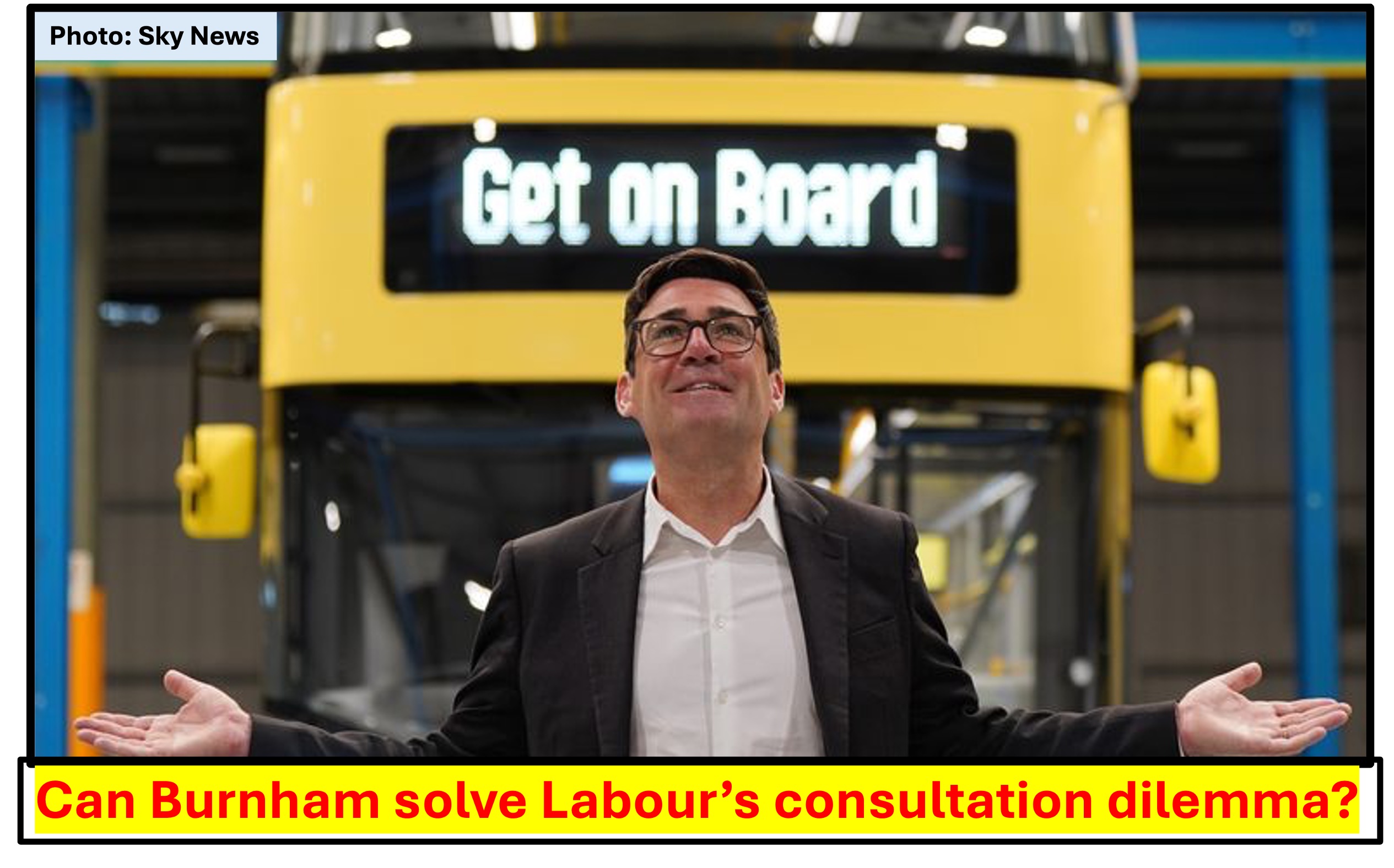
Andy Burnham takes the helm with a reputation for striking the right balance in Manchester – building strong relationships with the private sector alongside his proven commitment to working with communities. It may be because of his acknowledged skills in messaging to different audiences. Or also because he places so much emphasis on ‘problem-solving’ a more collegiate approach to addressing wicked issues.
In any event, the danger is, of course that a new Prime Minister will have little time to engage with the minutiae of public engagement. But he can set the tone for a nearly-new administration. Much will depend upon the team he assembles in 10 Downing Street and their willingness to recognise the value of good quality consultation.
We can but hope.
Rhion H Jones
July 2026
For more like this, and to receive the monthly Consultation Catch-up, click here
Leave a Comment
I hope you enjoyed this post. If you would like to, please leave a comment below.