This is Blog No 127
It’s the definitive outcome; the simple phrase that seeks to tell the world that you’ve listened. No-one questions it. And it’s a badge of honour for experienced professionals working in public and stakeholder consultation.
No-one wants to weaken the commitment to act upon consultee responses, or to demotivate those who organise consultations. But, just occasionally, one needs to question even the most well-established assumptions. (The image is meant to be a joke!)
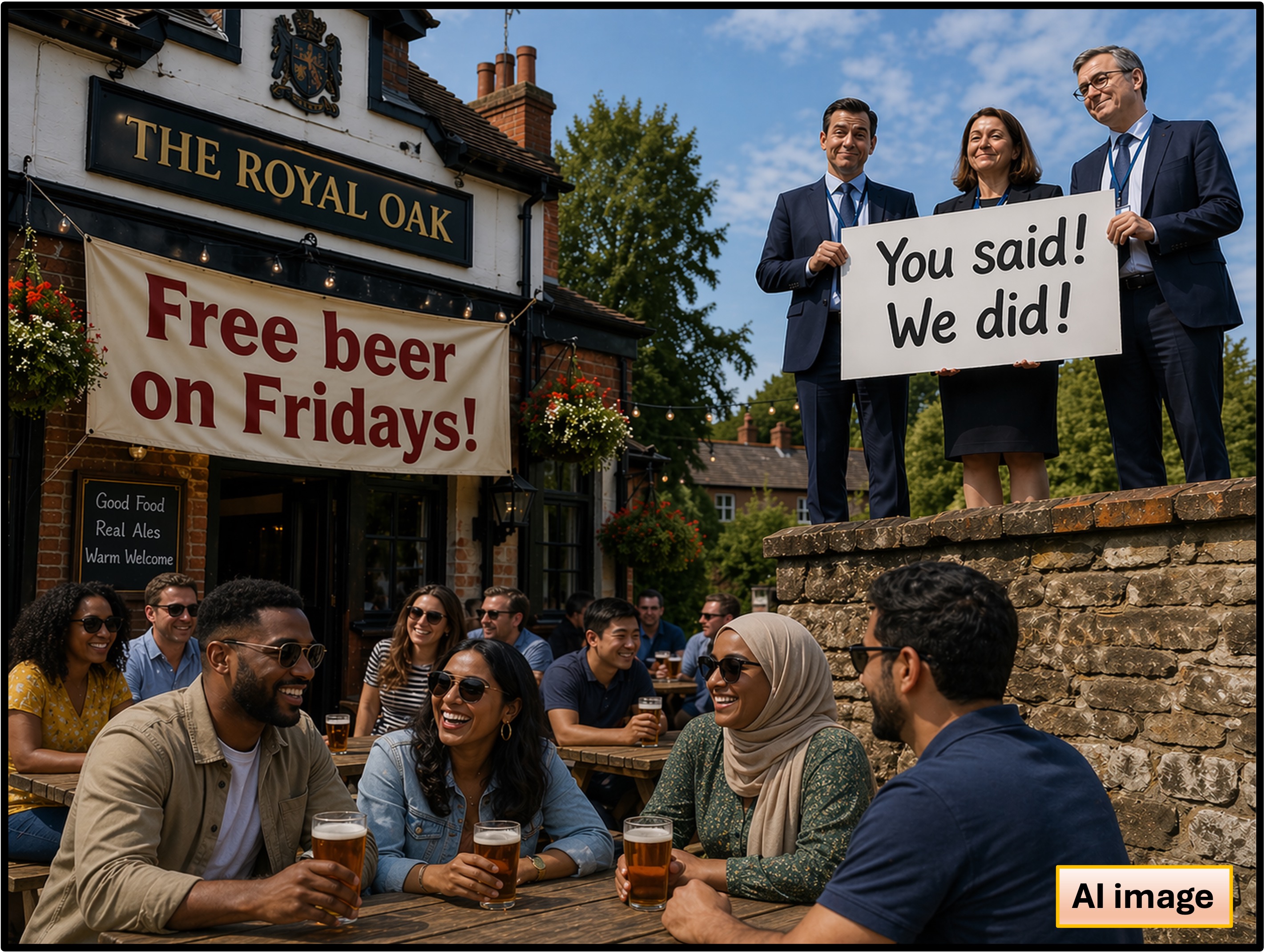
Here are three issues to make us pause for thought.
1. Who are YOU?
Consultees rarely speak with one voice. One of the purposes of consultation is to establish the diversity of viewpoints, and in particular to identify who says what.
A good recent example occurred in the consultation undertaken by OfSTED to establish a new framework for assessing schools following the tragic death of headteacher, Ruth Perry. The regulator conducted extensive engagement and organised a consultation where teachers strongly opposed the proposed new grading scheme. Parents, on the other hand, were more supportive, and OfSTED chose to listen to them rather than the teachers. (See Blog 119).
In this case – and many others, the consultor recognises that different stakeholders have opposing view and makes a judgement as to which side of the argument to favour. All this is fine, provided it is transparent, but complicates the simplicity of the “You said! we did!” message.
Over the years there have been many examples of consultors preferring responses with which they agreed, or to selectively rely upon the answers to some questions whilst ignoring others. One classic, (paraphrased) is “Good news; you all agree you want a higher standard of Accident & Emergency service” whilst ignoring the huge majority of consultees who opposed a proposal to close one A & E facility in order to centralise at an adjacent hospital. Another is the headline that proclaims “Everyone wants to support renewable energy from offshore wind farms” whilst overlooking the opposition to power lines or electricity sub-stations.
Consultation should not be just a quantitative exercise. We never tire of pointing out that IT IS NOT A VOTE. Despite this, there are consultative methods that legitimately rely on voting to establish the extent of agreement or disagreement. Well-organised Citizens Assemblies have, for years, sought to distinguish those conclusions that have most support from those who participate, and building their final recommendations around them. Where opinion is divided, the value often lies in a better understanding of the issues and the causes of dissent.
In contrast, proposals emerging from genuine co-production exercises can more credibly support a
“You said! we did!” outcome. Hopefully, differences of opinion have been accommodated, and solutions reflect the consolidated view of those who took part. Even here, however, there can be question-marks; often the age-old issues of Who was in the Room? and How did they get there? For a contemporary example, look at the current consultation on Special Educational Needs and Disability (SEND) in England. Government proposals, it claims, are the product of co-production with key stakeholders. It has not silenced critics who challenge the process and the resulting findings!
Whose views are being implemented is by no means obvious and is a question legitimately asked.
2. What exactly did you DO?
It is not always a linear logic. If this is a DETERMINATION consultation (See the FOUR FUNCTIONS FRAMEWORK) and a clear choice has been offered between Option A and Option B, a majority view in favour of one or the other that is accepted by the consultor can justify “You said! we did!”. But these are comparatively rare and really amounts to a referendum.
More typically, consultations are about priorities and preferences, and in order to be useful to decision-makers need to go beyond the headline decisions. The credibility of the consultor’s actions relies upon there being a direct ‘fit’ between these and the relevant consultee responses and this will often depend upon the precise wording of the question. Too frequently press releases quote consultees as having sought ‘improvements’ in this service or that, enabling the consultor to list a range of initiatives in response.
None of this is wrong, and it helps build a feedback narrative that organisations are taking consultee views seriously. What is less acceptable is to fall into the trap of focusing exclusively on the good news and ignoring less-positive responses. We do not often see the candour of public bodies admitting that “We did what you suggested on these matters, but could not on the others … for the following reasons”
There are good reasons why this is difficult. One is timescales. Some consultee responses can be immediately implemented, whilst others might take time or money not yet secured. In fact, in many cases of “You said! we did!” I recently reviewed, the actions were in fact, intentions … or promises to do something! In other words - “You said! we will!”
In many ways, that is a good outcome, for it might encourage the form of continuous engagement that extends the stakeholder dialogue and builds a better and more trusting relationship.
3. Was it the right response?
With consultation (as opposed to joint decision-making), the buck stops with the consultor. The process is something that helps organisations take better decisions but should not necessarily be conclusive. Just because consultees have a particular view, it does not mean that agreeing with them is the best or wisest course of action. Remember Boaty McBoatface!
Experienced Managers know well that the value of stakeholder input often depends upon who they are, whatinfluences their perspectives and how well the potential impact of proposals have been explained and considered in a consultation.
What makes life so hard for cash-strapped local authorities and the NHS is that consultations on specific changes will usually elicit a clear response that services users cannot tolerate reductions. It is not easy then to turn to those consultees, and in effect say “If we cannot make savings here, what other services would you like us to reduce…” As has often been observed, the public stance is often that they are much in favour of reduced public expenditure – as long as it is other people’s services or benefits that are reduced. In short, the crude application of “You said! we did!” can sometimes obscure the consequences of taking one set of actions on other services or policies.
Fortunately, there are great deliberative mechanisms available to engage stakeholder communities of all kinds so that more considered responses are possible. Citizens juries and similar forums, in person or online, can dig deeper into the underlying hopes and fears of individuals or groups. They can oblige participants to address difficult trade-offs and move beyond their instinctive reactions.
IN SUMMARY, transparency and simplicity means that “You said! we did!” remains a brilliant slogan It captures the key message that a consultation has had a purpose and been a valuable tool of participation in services management, delivery and policy-making. It’s part of the overall ‘feedback loop’ that helps build the credibility of future dialogues.
But we also need to be cautious not to reduce it to a formulaic knee-jerk reaction that glosses over some of the difficulties considered in this Blog. Consultation is far more than producing a list of consultee requests which organisations can proudly announce as being accepted. But when the facts justify using this catchphrase, it is a good way to demonstrate the value of listening - and being seen to listen.
And that can be the basis for a longer-lasting relationship of trust - something that is clearly needed.
Rhion H Jones LL.B
April 2026
For more like this, and to receive the monthly Consultation Catch-up, click here
Leave a Comment
I hope you enjoyed this post. If you would like to, please leave a comment below.