This is Blog No 119
In November, the High Court rejected a judicial review of OfSTED’s decision to replace its method of assessing schools.
Since the tragic death of headteacher, Ruth Perry, the issue has been an emotive one for everyone in the teaching profession and the Regulator’s search for a new methodology naturally attracted much attention and concern.
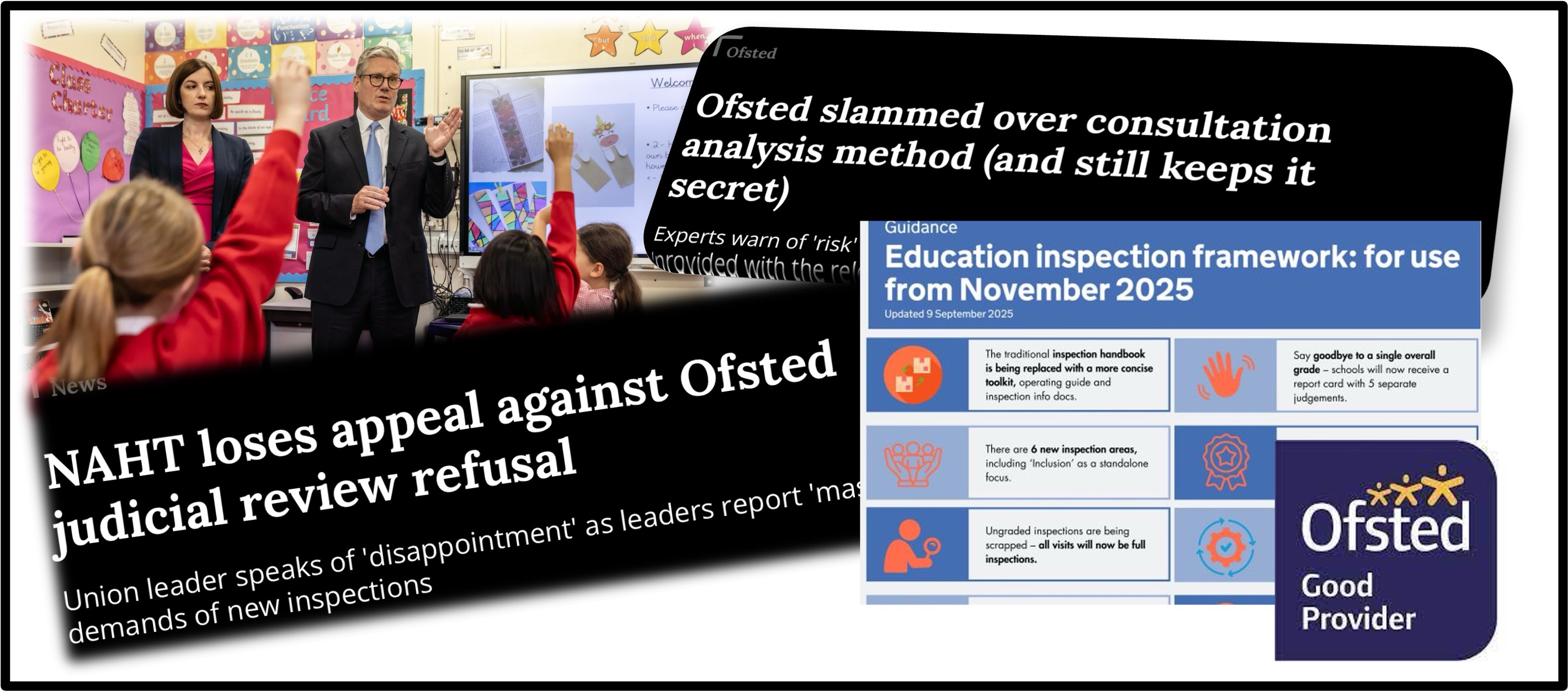
The case of R (Nat Assoc of Headteachers & Middleton) v Office for Standards in Education sheds interesting lights on the issues that arise when consultees believe that decisions with which they disagree have been taken improperly, and when the consultation process was flawed.
The Judge disagreed. Mr Justice Saini ruled that although OfSTED’s consultation’s was based on its strong preference for a new five-point scale, it did not amount to pre-determination. Headteachers had argued that by the time that consultation was issued in February, OfSTED’s mind was effectively made up, and the exercise was essentially a foregone conclusion. Most cases of this kind – relying on the first Gunning Principle (‘formative stage’) are VERY fact-specific, and consultors are quite adept at persuading Judges that, of course they still had an open mind!
Experienced practitioners, on the other hand, know well that there is a fine line between having a ‘pre-disposition’ towards as particular course of action – which is perfectly lawful and actual ‘pre-determination’, which is not!
In this case, OfSTED had launched a process they called ‘The Big Listen’, which covered a much wider agenda – effectively – to use the FOUR FUNCTIONS FRAMEWORK terminology, a NAVIGATION exercise – exploring many topics going to the heart of the Regulators’ purpose and culture. It boasted 30,000 responses and included stakeholder sessions called ‘social partnership meetings’ during which the claimants formed the view that OfSTED was already committed to the new 5-point scale and was not interested in pursuing alternatives. A few months later, the consultation paper itself was published, and it was this that was considered satisfactory by the Judge.
Now, I don’t know how many public consultation documents Mr Justice Saini has looked at, and on the facts presented to him, it’s hard to question his judgement that OfSTED still had an open mind. But to experienced practitioners, there are some interesting features to this paper. There are, in fact five different Proposals, but they are not choices of one or another. Proposal One is the only one that covers the methodology of assessing schools etc. It is undoubtedly the consultor’s ‘preferred’ solution. A considerable amount of detail is published, as well as short paragraphs mentioning some variations that had been rejected.
Ever since the seminal 2014 Supreme Court judgment in Moseley v LB of Haringey, there has been a focus on ‘discarded options’, so as to assure consultees that it is not a fait accompli. To be lawful, the consultation would need to demonstrate that those ‘discarded options’ had been considered. In this case, the consultation paper identified four variations to the preferred 5-point scale; a binary yes/no, a 3-point, a 4-point and a 7-point scale. The solution that headteachers had championed – a narrative only report – as adopted in Wales and N Ireland – was not mentioned, so they argued that the rejection of their method had already been pre-determined. Again, the Court saw it differently. In the eyes of Mr Justice Sinai, OfSTED’s consultation still allowed for the possibility that it could change its mind.
This is an excellent illustration of problems that arise when EXPLORATION consultations (options selection) become confused with DETERMINATION (making a choice). The decision to exclude the Headteachers preference was presumably taken by OfSTED in the months leading up to the publication of the main consultation. Yet they were able to convince the Judge that there had been no pre-determination.
Probably this was because the consultation was well enough drafted to give opponents to Proposal One an opportunity to state their case? It included the familiar catch-all question “Do you have any other ideas we could consider?”. There is precedent. It is one of the reasons why the Court of Appeal reversed the High Court decision in the well-known NHS case of the Royal Brompton Hospital children’s cardiac unit back in 2012, where all the consultation’s proposals had excluded the possibility of keeping it open,
Both that and the recent case illustrate the difference between the legal process and real life. The Judge may be correct in law, but consultation works best where there is a reasonable degree of trust between the consultor and its consultees. A confused EXPLORATION process culminating in a decision that is not very transparent, to exclude a key stakeholder’s preferred solution is bound to create dissatisfaction, antagonise its critics and to erode that necessary level of trust.
The saving grace, of course is that normally a Consultation output Report clarifies things. It should explain who said what and provide a rationale for the decision taken. Only here too there was a problem, for OfSTED chose to analyse the data using AI and the methodology has come in for considerable criticism. Respected specialists in data analysis have expressed misgivings about several aspects of the process, but none of this surfaced in Court.
It’s only a matter of time.
Although pre-determination remains a key issue, policy decisions will increasingly be questioned on the grounds that consultors have not given ‘conscientious consideration’ to the output of the exercise. (Gunning Four). It will put AI-assisted methods under the microscope – and as in this case – oblige an organisation to be open and honest about ALL aspects of their consultation process.
Rhion H Jones,
January 2026
For more like this, and to receive the monthly Consultation Catch-up, click here
Leave a Comment
I hope you enjoyed this post. If you would like to, please leave a comment below.