This is Blog No 126
The pollsters say that May’s local elections will bring about significant changes to the political complexion of English local authorities.
For officers working in local government, there are many uncertainties. What will change? And will the current ways of working survive a sea-change in political and social expectations?
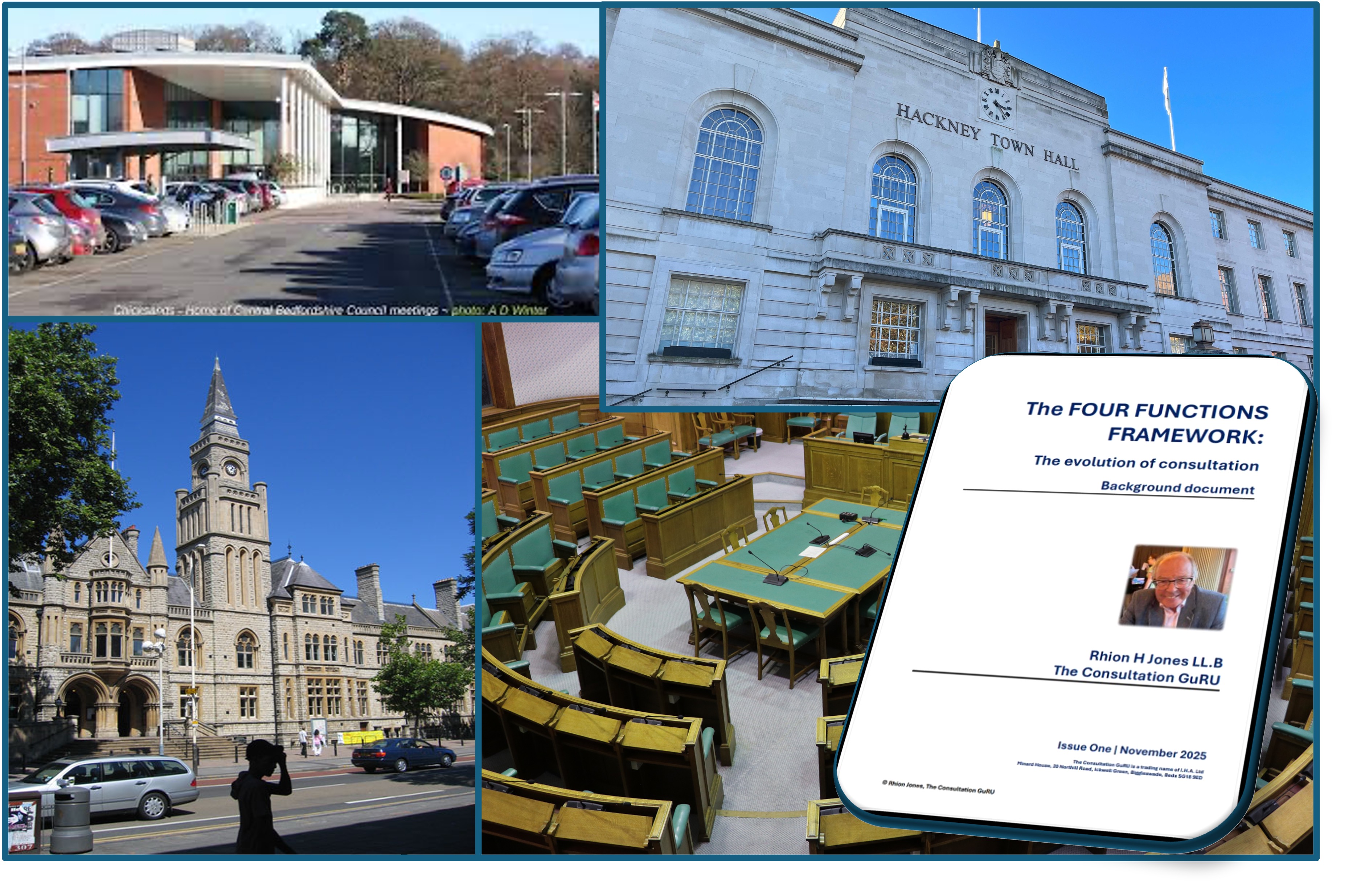
Government Ministers say they want to reform the ‘consultation culture’ in Whitehall because it sees it as delaying and complicating policy implementation. Does a similar situation exist in our Councils and is there likely to be a similar impetus to change?
The answer is YES… But there are big differences.
Generally speaking, over the years, local authorities have been better at public consultation than central government. It is partly because they are closer to their communities and have a better idea of who to consult and on what subjects. Also, local government officers – and elected members - have been in situ for longer, have accumulated valuable local insights and possess considerable experience of running public engagement.
Unlike civil servants who often rotate from one department to another and who organise a consultation once every few years – local officials have a depth of ‘domain knowledge’ upon which to draw. Many also invested in good, solid consultation training with the Consultation Institute!
But now consider the changes that may occur when the ballot boxes are counted in May. Up to 40 Councils are predicted to change political control. More will revert to ‘no overall control’ with unpredictable consequences for key policy areas on contentious issues like local net-zero policies, transport or housing. We will see an influx of inexperienced Councillors. This may be a good thing for a vibrant democracy, but it needs a training investment and a degree of hand-holding as they learn what levers they can pull – and what they can’t.
Add to this, the immense upheaval of local government reform with some new Mayoral Councils having elections, many brand new Councils being formed and lots of small Districts voting for authorities that may not exist much longer. Change is also forecast in the Welsh Senedd and in Scotland and although the SNP is expected to retain power, its uneasy relationship with local government hardly appears a stable scenario.
And, of course, Councils are chronically short of money. Everywhere.
So, for those who organise public consultations, this is a terrific challenge.
- Many Councils will come into power on a vague platform of ‘change’ but without being certain where or how to make it happen. Not all of them will want to consult the stakeholders whose views might help them! Remember – there is a lot of hubris in politics!
- For anything to do with public services – and paying for them, there are relatively few options. And some unpalatable implications.
- Trust levels in public institutions remain low. Councillors and officials are rightly alarmed by the discourse on social media, and genuine engagement with young people and other seldom-heard communities is patchy or worse.
- Communications and engagement staff have been reduced and are overstretched. The NHS has recently (and foolishly in my view) made large redundancies among its patient and public engagement teams and local authorities will be left to pick up the pieces when health and wellbeing issues become controversial.
- New brooms like sweeping clean …!
The GOOD NEWS is that this becomes a perfect time to re-think some traditional ways of working and bring some new ideas to the fore.
Consultation is a case in point. Many of our current methodologies are decades old. The legal rules (The Gunning principles) date from 1985; many of the systems we use were installed fifteen years ago. And our established ‘consultation paper + questionnaire’ model pre-dates the online age and is not always now fit for purpose.
Purpose’ is, in fact the key word. Too many consultations follow the same formula even though the function they need to perform varies. That is why I have published the FOUR FUNCTIONS FRAMEWORK - a brand new way to approach the never-ending requests or requirements to consult. My suggestion is that before reaching for the growing toolset of consultation methods, we should ask ourselves What function is this consultation intended to perform?
So, I have identified four generic functions:
- NAVIGATION – What are our objectives? Where are we trying to go?
- EXPLORATION – What are the various ways we could get there? What are the ideas or options?
- DETERMINATION – The choices we have to make between alternative actions
- IMPLEMENTATION – How can we give effect to decisions or projects.
The point is that these have very different characteristics. They might involve different methods and timescales. The stakeholder profile may be different, different expectations may need to be set – and different methodologies and standards adopted.
How would these map across to the kind of public engagement/consultation scenarios likely to arise after the May Elections? Here are a few example:
- A new Council will need to take a fresh look at its social priorities and foster a sense of identity. This could be a NAVIGATION consultation – maybe invest in a full-scale Citizens’ Assembly, or a series of Stakeholder Panels(Businesses; Young People; civil society leaders etc).
- Addressing a projected three-year Budget deficit of many £millions and seeking citizens and stakeholder views on various potential savings. These are EXPLORATION consultations – looking at a wide variety of options, and a good use of Co-production. For possible changes affecting specialist Council services, consider calls-for-evidence and for very controversial re-configurations maybe a Citizens Jury.
- The local NHS Board wants to work with a local authority to prepare for the forthcoming Neighbourhood Health initiative and needs input on residents’ preferences for the location of some services. This is also an EXPLORATION consultation as there are, as yet, no firm proposals, and the consultor bodies just want to identify possible solutions or resident preferences. Setting up a Stakeholder reference group, organising some deliberative events and probably a managed online forum would be effective here.
- An authority has a Community Safety/Crime Reduction strategy and wants the maximum public endorsement for its approach. Before its adoption and funding, it wants to be seen to have heard the views of the public. This is a decision that should be treated as a DETERMINATION consultation, best done with the dissemination of explanatory literature, public events and drop-in centres with opportunities to engage with residents who might not otherwise respond to a more traditional form of consultation.
- A Council is expecting commercial interest in developing a greenfield out-of-town site for retail and leisure purposes. There are three potential sites and before finalising its local plan, it wants to test local opinion. This also is a DETERMINATION consultation and probably involves a document that includes outline impact assessments and maybe some public meetings to hear the views of attendees.
- A costly Town Centre redevelopment is already well under way and unforeseen public reaction to the disruption is of concern to the Council. It needs to find ways to connect with those affected and provide better forms of dialogue with residents about the project. This will be an IMPLEMENTATION consultation – probably taking the form of continuous engagement and best done with modern online community liaison tools and the formation of online consultee panels.
The point about all of these is that by working from the function of a consultation, it is possible to reduce widespread confusion as to the nature of the exercise. It also provides public engagement practitioners with a logic whereby they can recommend using more agile, quicker and often cheaper forms of engagement without as much criticism from those who still prefer the more traditional methods.
I predict that after the May elections, there will be many scenarios similar to my examples and that a new generation of elected members will welcome signs that Councils will take a fresh look at the best ways to consult the electorate – and key stakeholders.
Before long, I hope to recruit several experienced colleagues to act as Four Functions Champions and will work with them to help any Council which is interested in adapting and applying this Framework in their own authorities.
Read the full Framework document here
Rhion H Jones LL.B
April 2026
For more like this, and to receive the monthly Consultation Catch-up, click here
Leave a Comment
I hope you enjoyed this post. If you would like to, please leave a comment below.