This is Blog No 135
Four weeks into a new administration and it looks as if this Prime Minister gets the message – that perceived change needs to be accelerated … and be more visible.
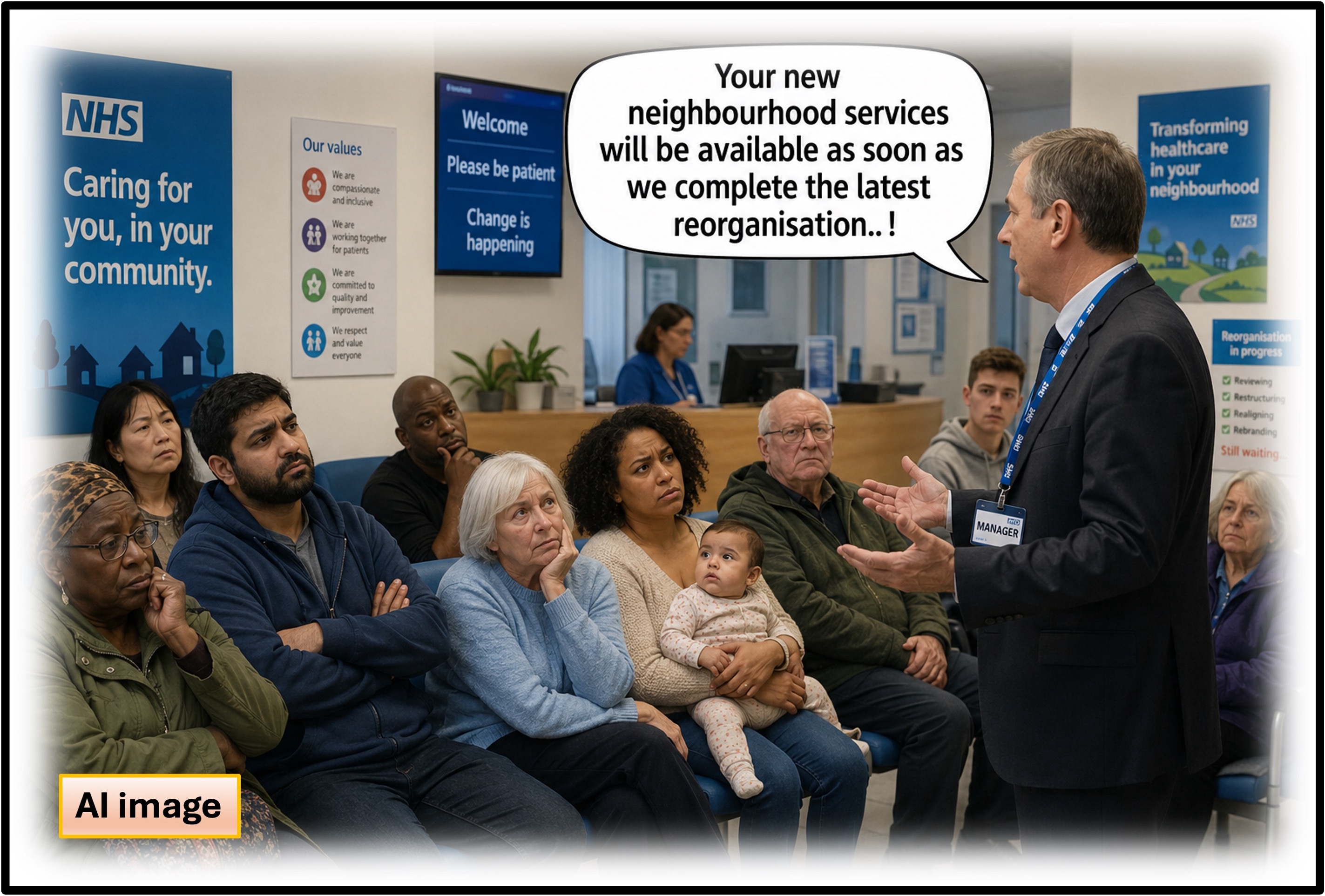
‘Perceived’ is an important word in this context. Keir Starmer’s colleagues would claim that many Labour policies will indeed bring about significant change – in planning, in transport, in employment rights and, of course in health. Andy Burnham’s friends would respond that the pace of change was always too slow and failed to match the rhetoric. Hence his flurry of early announcements and initiatives – mostly to transform the mood music – but also to pave the way for more radical change.
In the Rewiring the State Cabinet statement, 10 Downing Street (north and south!) is doubling down on this commitment with far more seismic alterations to current ways of working. The extent to which individuals’ lives will be affected is a fascinating debate. But in one area, there can be little doubt – the National Health Service
And there, Burnham inherits a challenging reorganisation only partially implemented and a far-reaching commitment in England to build a new delivery system around the plan for Neighbourhood health.
However, two recent, pre-Burnham documents give me cause for concern. One is the latest iteration of the all-important Planning, Assuring and delivering service change for patients guidance which emerged on 25th June. The other is dated July 16th and is the consultation on the proposed contracting framework for supporting Neighbourhood health services – both applicable only in England.
The first is the well-established mechanism for managing ‘service changes’ to meet the legislation that has remained virtually unchanged for 25 years. The document is long, complex, repetitive and enough to deter all but the most determined bureaucrat from venturing anywhere near changes that would invoke these provisions. Maybe that is why the pace of real change appears to many to be disappointing.
In practice much has changed, and this is often due to diligent specialists in patient and public involvement who have mastered the intricacies of successive Guidance and usually engaged successfully and constructively with local communities. Much of their work was below the radar, and it is to Wes Streeting’s discredit that he was persuaded to make so many of them redundant.
If hell-bent on reducing the numbers of people engaging local communities, Health Ministers had a choice. They could have either retained the existing legal framework but make the Guidance far less prescriptive – or use the current Health Bill to simplify the statutory requirement and recognise that the hollowed-out management capability is no longer sufficient to do justice to the original legislative intention.
What you can’t do is maintain business as usual – with the existing convoluted processes without sufficient staff with the expertise to follow them.
When it comes to neighbourhood health, there are two matters upon which local communities will expect to have a say.
- One is the precise definition – or delineation – of the ‘neighbourhood’ area footprint. Local people know that where the boundaries are drawn will affect what is likely to be delivered where.
- The other is who will deliver the service? Currently NHS England is seeking views on the single neighbourhood provider (SNP) or the multi-neighbourhood provider (MNP). This may influence the extent to which your local services are going to be organised by GPs or by the local hospital trust.
Before the cull of engagement experts, parts of the NHS had become rather good at involving people in designing new patient pathways and improving existing services. Many developed excellent working relationships with local HEALTHWATCH (whose proposed abolition is another Streeting mistake – hopefully to be rescinded by the new Health secretary – See Blog 131) and other patient participation groups.
Embarking upon the vast number of potential service changes implicit in the development of neighbourhood health whilst trying to follow the existing legislative provisions and the new, un-simplified Guidance is a recipe for conflict and confusion. The interdependence of changes one upon another and the challenge of sequencing multiple process alterations will affect almost every new neighbourhood that appears. London is already ahead of the game and is promised 141 of them – with an average population of 61,000. Apply that ratio to the whole of England – and there will be a lot of service change
The intention appears to be to secure local accountability for key early decisions through Health and Wellbeing Boards– shadowy bodies wholly invisible to the general public and scarcely a shining beacon of municipal leadership in most areas. This is made even worse by the fact that huge swathes of England are deep in the distress of local government reorganisation with amalgamations and rationalisations totally disrupting lines of representation. What chance is there of genuine patient and public involvement in setting up the new, more localised health service?
Of course, with goodwill, people will muddle through. They usually do. But we could and should do better. For an insight into what is really desirable, read a much more impressive paper by Cormac Russell and Lisa McNally for New Local. It is called Putting the Neighbourhood Back into Neighbourhood Health. and is a first rate analysis of the potential for improving health and wellbeing by harnessing the wider capabilities of communities – rather than focusing exclusively on clinical care and allied interventions. The authors admit their paper is a ‘provocation’, but much of the Burnham regime’s early signals suggests they agree that investment needs to be less top-down and more bottom-up.
BRINGING ALL THIS TOGETHER, the instinct of the moment is a willingness to de-centralise and devolve. Everywhere. Not just on health, but on matters of transport, justice, housing, skills and even local taxation.
My question is how to ensure that local people have a meaningful voice. Not just superficial, social media, AI-generated campaigning manipulated by vested interests or worse. Real views from real people having a real understanding of what real alternatives might be possible. Complex procedures for consultation may no longer be fit for these purposes – hence my promoting the new FOUR FUNCTIONS FRAMEWORK. But, for certain, the NHS – and others - need public engagement practitioners with the know-how to ask the right questions and build constructively and collaboratively from community responses.
Many who have recently left the NHS possess these skills … and they will surely be needed.
Rhion H Jones LL.B
August 2026
Leave a Comment
I hope you enjoyed this post. If you would like to, please leave a comment below.