This is Blog no 118
Changing one’s mind is not, of itself, a bad thing. But in politics it has become toxic.
Tabloid papers who know no better use the term to belittle politicians, no matter what the subject. And political commentators and podcasters – who should know better - are often equally guilty. No wonder our democracy is struggling!
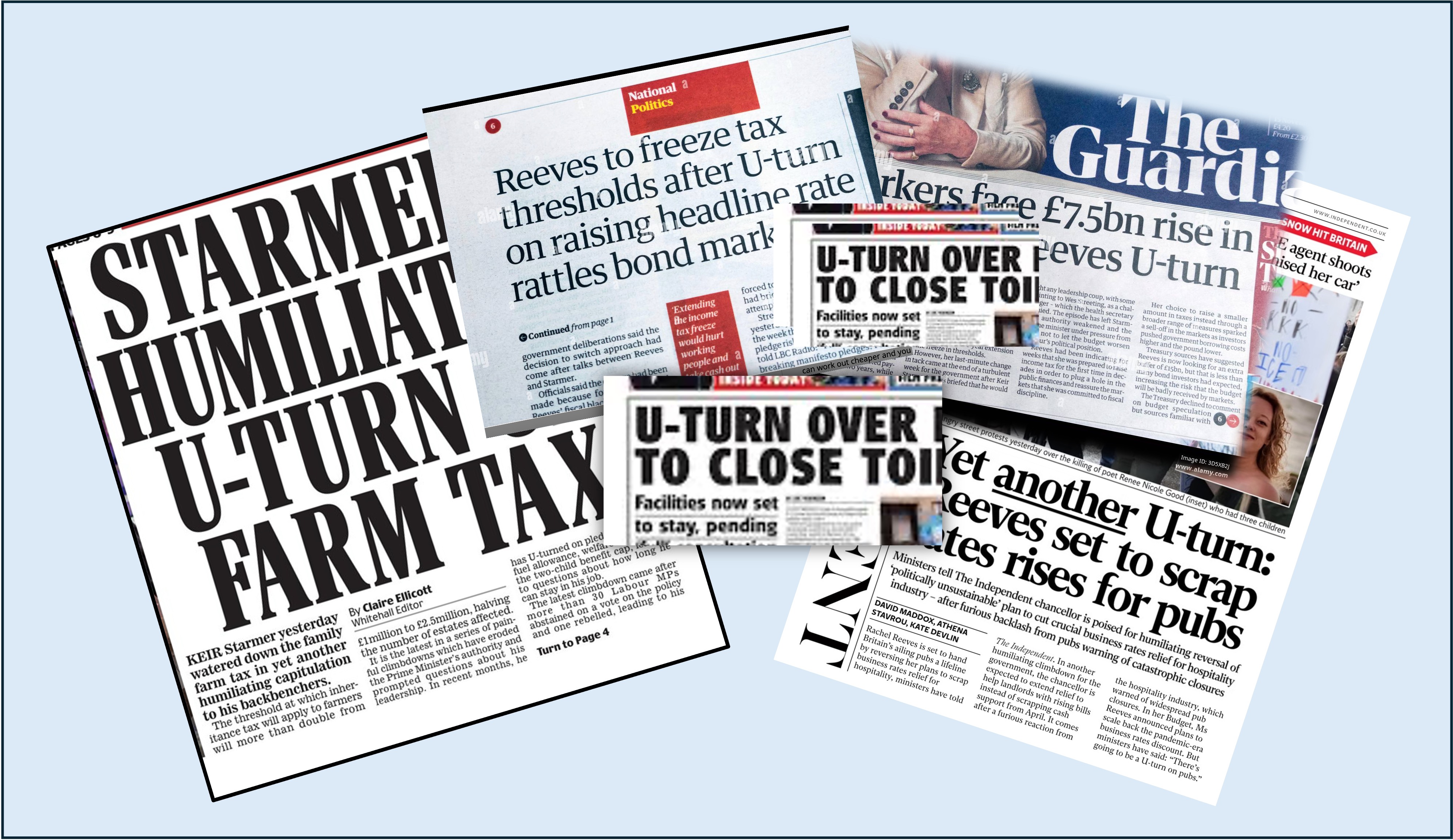
Of course, there are times when a U-turn reflects Ministerial indecision, confusion and worse. But there are also situations where it reflects new information, reconsidered priorities and a conscious attempt to adopt more realistic policies. This Blog asks a very precise question; would better stakeholder engagement reduce the risk of U-turns?
Despite the current feeding frenzy as the Labour Government fends off allegations of incompetence because of the number and nature of policy reversals, the truth is that every Government in recent years has changed course regularly. Without dwelling on Liz Truss’ speedy volte-face on its entire economic policy, the Conservative Government that followed U-turned on High-Speed Two, electric cars, closing railway ticket office and many more issues. Well before it won the Election, the Labour opposition had also been forced to abandon its ambitious plan to invest £28bn per annum into green industries.
Policy reversals come in different forms.
- There are those that are ‘course corrections’ backtracking on previous announcements of half-baked, over-optimistic aspirations. Most Oppositions encumber themselves with such albatrosses and are only too pleased to be relieved of them. Labour probably now regard the Green investment in this light.
- There are those that become impossible to implement. Maybe it is due to lack of money, or because the original assumptions prove to have been wrong. At times, policies only make sense if certain pre-conditions exist. Trade policies proposed before Donald Trump upended the international system might clearly need a rethink.
- Some U-turns arise from new research that change the benefits-profile. Often it is a question of pure arithmetic; the sums don’t add up. Treasury officials have often been heard to complain about the optimism of politicians when predicting the yields of new or amended taxes! It’s also amazing how they can underestimate the costs. SEND is a great example.
Most attention, however, is focused on U-turns that happen because of a change in the political calculus. Decisions that seemed fine and defensible when the going was good become less tenable if they become too unpopular. There appears a tipping-point when disapproval of a policy starts to threaten the number of votes cast in the ballot-box, or the likelihood of securing support in Parliament itself.
Consider the spate of U-turns for which the Starmer regime is criticised.
- There are many economists who would have supported the withdrawal of the Winter Fuel Allowance, but its announcement caught MPs and public unprepared. It took months of simmering anger and relentless pressure from charities and welfare activists to force a partial reversal.
- The belated implementation of a Manifesto commitment to end the benefits cap for those with more two-children is seen as a U-turn (as opposed to a delay) because the Party whip was withdrawn from MPs who demanded it earlier. As often happens, rebellions from your own side are more likely to force changes than anything said by your opponents.
- Applying revised inheritance tax rules for agriculture led to an attritional year-long campaign by the powerful farming lobby, forcing Ministers to abandon its plans despite a year defending them.
- The unpopularity of Budget announcements reducing COVID-time discounts on business rates for hospitality led to many MPs being barred from their local pubs over Christmas. Unsurprisingly, a U-turn is imminent!
What all these have in common is the active involvement of trade associations and other ‘stakeholder’ organisations. It is they who provide the research data, seed social media and feed the traditional channels. In fact, there is now a sophisticated industry converting political arguments into political action. Political lobbying, of course, has been with us for decades. What is different is that the age of 24-hour news, podcasting and perpetual political analysis, there are endless opportunities to promote causes and complaints. All Governments have been susceptible to pressure – and conventional wisdom holds that the greater the propensity to U-turn, the greater the incentive to campaign. That’s why Margaret Thatcher’s famous declamation “The Lady’s not for turning.” is seen as the classic signal of unresponsive resolve.
When applied to the poll tax, it destroyed her!
So – returning to the central question. Would better dialogue with stakeholders have made a difference?, there are several answers, depending upon the quality of the stakeholder relationships. Ex-Strategy Director at 10 Downing Street, Paul Ovenden presumably does not think so. In a Times article, he recently blamed ‘The stakeholder state’ for the problems of securing change in British politics. Ministers, he claimed are hobbled by “a complex coalition of campaign groups, regulators, litigators, trade bodies and well-networked organisations … and incubated by a political perma-class that exists within every party and every department.” We know where he stands then.
Equally relevant may be the structure of the civil service, Over the years, countless reports have criticised the cult of the ‘amateur’ that once deemed that a good Oxbridge education could be more valuable than specialist domain knowledge. Much of this is about institutional memory but it also reflects the ability of officials to continuously engage credibly with key stakeholders. When successive cuts to the civil service eroded these relationships, much UK policymaking became effectively outsourced to Think Tanks. If new flaky ideas or manifesto commitments emerge these days, it may not be a failure of stakeholder engagement by the politicians and civil servants, but by partisan Think Tanks with little incentive to identity the flaws in their pet proposals!
It also depends on which stakeholders you consult? Trade bodies and others with a vested interest can be relied upon to seek to defend their interests. But it is the job of astute policymakers to seek out and engage the less obvious voices – effectively to listen to all sides of an argument! That is why an open, public consultation is almost always better than selective, secretive conversations behind closed doors.
In Peter Walker’s Guardian article on 8th January, he quotes an unnamed Labour MP expressing his or her concern in the following terms:
“When the government thoroughly consults ahead of producing policy, it goes really well. However,
whenever it presses ahead with plans without the engagement of people with lived experience, or
backbench MPs with their finger on the pulse, it ends up in the wrong place. I very much hope
government is willing to listen and engage more, so it gets things right first time.”
I could not have put it better myself.
Rhion H Jones LL.B
January 2026
For more like this, and to receive the monthly Consultation Catch-up, click here
Leave a Comment
I hope you enjoyed this post. If you would like to, please leave a comment below.