This is Blog 143
A timely reflection
As everyone now knows, Government Ministers are very exercised by the ‘dither and delay’ caused by unnecessary public and stakeholder consultation. Much of this is fuelled by concern that opponents to their policies can too easily run to the High Court to complain about their decisions.
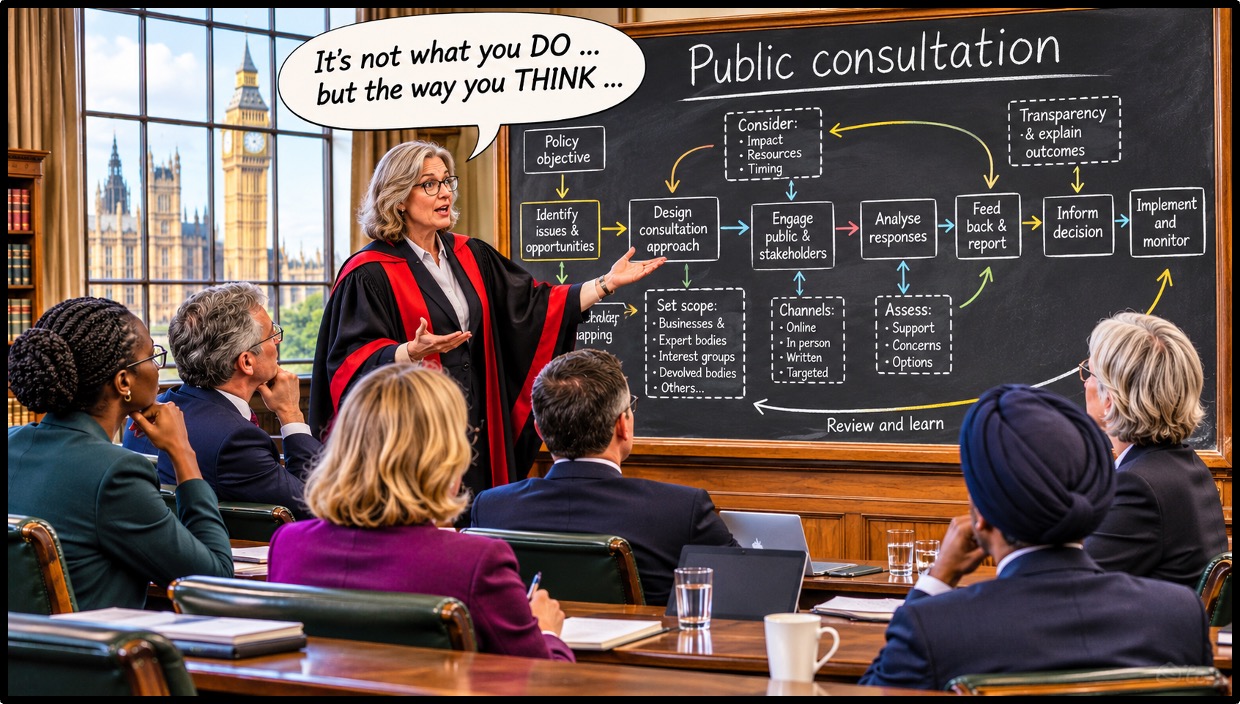
Of course, when claimants arrive in Court they will find that Judges cannot look at the merits of any decision – just the process. In the words of Judge Laws in 1995, “The only question for the judge is whether the decision taken by the body under review was one which it was legally permitted to take in the way it did” For anyone wanting to take their case to Court, the overwhelming priority is therefore to look furiously for any process irregularity. Anything that enables claimants to argue that they were subject to an unfair process!
Unsurprising therefore if consultor organisations live in fear that administrative oversights in running a public consultation can lead to expensive and lengthy legal proceedings. It has led to a defensive approach to consultation. An eagerness to tick all the boxes and bend over backwards to avoid any possible allegation of unfairness. It adds to the perception that undertaking a consultation is high-risk as well as high-cost.
In many ways this has had a beneficial effect. The number of high-profile legal challenges against NHS reconfigurations between 1995 and 2015, many on grounds of poor consultation, helped Managers eliminate obvious errors. This was accomplished in part by sets of mandatory Guidance and enough management commitment to ensure that they were largely observed. In other sectors, similar process toolkits have served the same purpose. Training providers such as the Consultation Institute ( which I directly managed from 2003 to 2017) taught thousands of public engagement practitioners how to observe best practice!
I’m now wondering if, maybe we overdid it? Did we elevate the need to procedural purity to the point that it created undue anxiety and encourage mechanistic adherence to the rules rather than a broader understanding of the fundamentals? Have we created the classic case of being unable to see the wood for the trees?
So here is a thought.
Maybe consultation is not predominantly about process? It’s about an attitude of mind.
Being consultative means being open to others’ opinions and willing to re-consider your position. It’s the opposite of being autocratic and driven by total certainty. It means being open to influence – and happy for this to be visible to others. It is also a pragmatic response to uncertainty.
The trouble is that in a democracy, politics does not always reward such behaviour. In the opening pages of The Politics of Consultation (2018), Elizabeth Gammell and I tried to capture the dilemma and wrote
“Elections favour those with certainty in their souls. We expect our future leaders to know what they
believe and to admit of few doubts. It’s probably a little like religion. Worshipping in the church of the
doubtful sounds a little tentative. One of the reasons for going there is to hear the clarion call of those
whose lien on righteousness cannot be denied. The politician who admits of too many uncertainties is a
bit of a rarity.”
Outwardly, politicians need to demonstrate certainty; inwardly many recognise that they do not have a monopoly of wisdom and rely heavily on civil servants to help them convert their best intentions into reality. Many novice Ministers have been shocked to find the horrendous complexities of drafting and securing the passage of primary legislation and the detailed nuances and implications of even the simplest of enactments. When officials offer them a choice from several ways of doing something, many a politician has wondered whether it might be possible to seek the views of key stakeholders!
This is one reason for the growth in officials boasting the word ‘stakeholder’ in their job titles. Engaging with interest parties is all the rage. But it is not quite the consultation mentality that recognises that one needs to further than just initiating or maintaining a dialogue. The consultation-minded are imbued with an appropriate degree of respect for those they consult. It‘s what drives their commitment always to provide the full unvarnished truth about what they propose and provides the optimum opportunity for consultee views to be considered.
A consultative mindset is one where a Minister or Chief Executive considering a possible consultation would never …ever … go ahead if he or she knew that the decision was effectively already taken. If this sounds suspiciously like a walking, talking set of Gunning Principles, then that’s because they remain, forty years on, still the best embodiment of what it means to be consultative.
Maybe we should view the acid test as being whether a consultation has an honest intent. By this we mean that it is being done for the right reasons – a genuine desire to hear relevant opinions before taking action. It applies regardless of the purpose of the exercise. Whether the idea is to chart a way forward (i.e. NAVIGATION) or to identify viable options for consideration (i.e. EXPLORATION) . Or whether one is consulting about hard choices (i.e. DETERMINATION) or putting them into effect (i.e. IMPLEMENTATION), the fundamentals are the same.
Adopting the FOUR FUNCTIONS FRAMEWORK has many implications for the processes that are most suitable for these different scenarios. It should enable a more agile approach to consultation overall. It should help organisations choose what method is most appropriate, and applying best practice is important for effectiveness and perceived legitimacy. But procedural irregularities consultation often be less critical than a flawed approach to the exercise.
How therefore should we mentor or train new entrants to the public engagement profession? They still need to learn from those experienced in the various methodologies; how to organise co-production or a citizens’ jury; how to design surveys or facilitate focus groups. They may also need to learn about impact assessments and how to run system tools.
But no amount of process excellence can substitute for a sound appreciation of consultation values and a commitment to observing them consistently.
As the debate on consultation reform continues and various ideas compete for the Government’s approval, let’s keep these fundamentals in mind.
Rhion H Jones
October 2026
For more like this, and to receive the monthly Consultation Catch-up, click here
Leave a Comment
I hope you enjoyed this post. If you would like to, please leave a comment below.