This is Blog No 129
I’ve just been reading the Government’s new Health Bill – that puts recent organisational changes to the NHS on a statutory footing.
Amid the mind-boggling gobbledegook of legal text is the need to re-state or revise the legal rights and obligations of the various bodies that constitute the NHS. It includes the decades-old commitment to engage (maybe by consultation) with patients and the public when significant service changes are being considered
NHS England was the author of much of the relevant guidance that governed how these were managed, and though the legal label changed over the years, they are widely known as ‘the Section 242 provisions.’
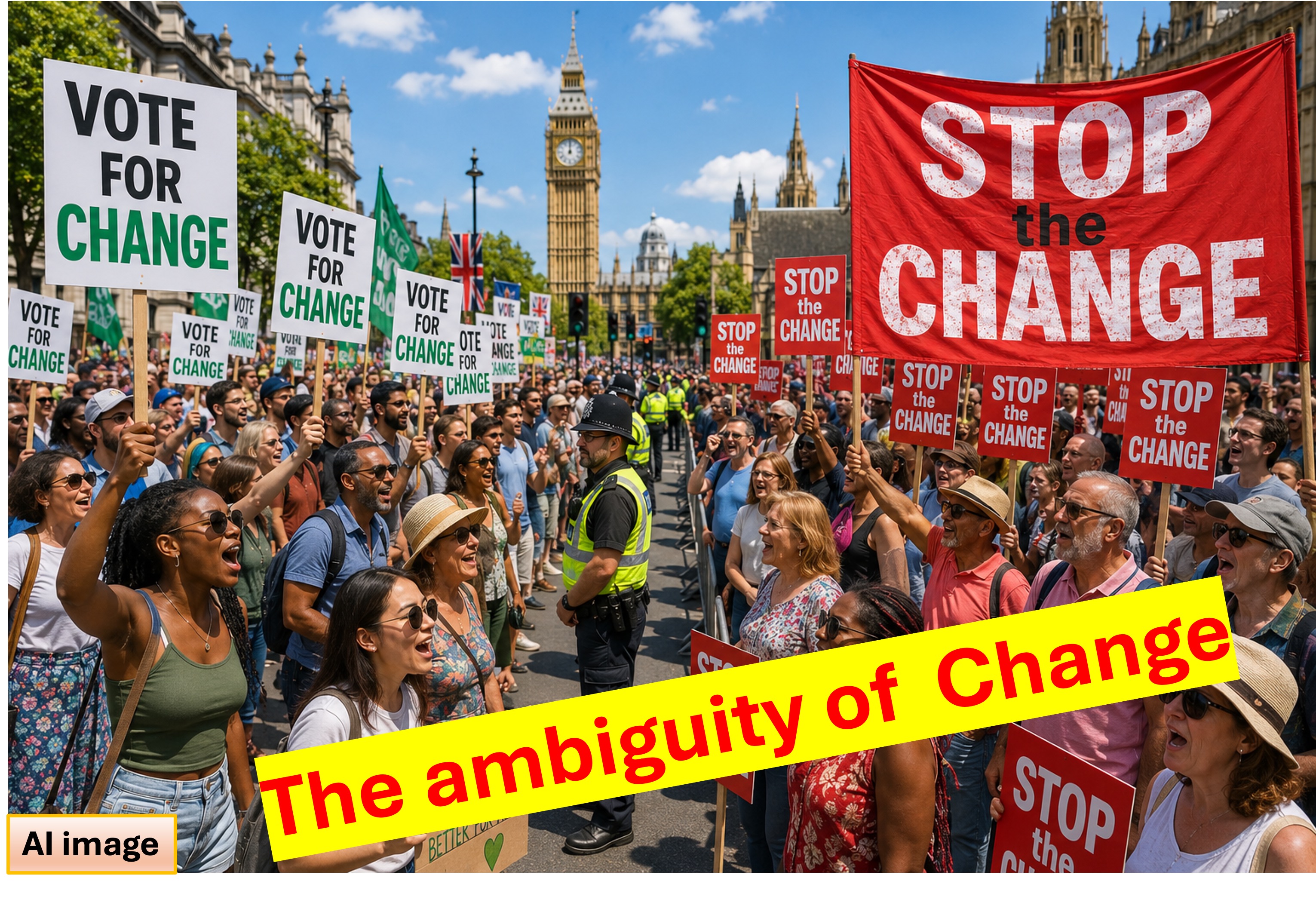
So, right now, there are many worries as to how these can be conscientiously observed now that Ministers have seen fit to remove from office a large percentage of those who had the skills and know-how to manage patient and public involvement. But equally concerning is our ambivalence about CHANGE – not just in the NHS but in the wider political world.
We are told by pollsters and commentators that public dissatisfaction and recent election results reflect people’s desire for CHANGE. That is not surprising given that the General Election was won by a party whose ‘one-word’ message was CHANGE, and whose massive Parliamentary majority was probably achieved by an electorate that chose to vote against the incumbents rather than for an alternative vision. The problem is that everyone has a different vision of change. Only when exposed to a choice between a current status and a (properly impact-assessed) alternative can we gauge how enticing is the prospect of that CHANGE.
The NHS provides us with countless examples. It is the one area where – thanks to the S.242 provisions, we have ample evidence of how people respond to proposed changes. And the picture is not always encouraging. Health providers have consistently developed better clinical and administrative pathways for patients only to find that thousands of people mount the barricades in defence of the status-quo. Managers then have to navigate an exhaustive and exhausting process of consultation, and in the case of extensive re-configurations, an appeal mechanism (latterly a call-in process) that can extend the process so much that before they implement one set of changes, other newer innovations are already imminent. It’s not only HS2 that takes too long and costs too much. No wonder highly-committed NHS leaders have despaired of the process.
It can be done well – with experienced practitioners who know how to frame proposals, insist on mitigations and engage with communities effectively. But, as my friends, Paul Parsons and Caroline Latta – who established Olovus to do these things properly, always remind me, public misgivings need to be understood and accommodated. Communities DO want change, but only when they can see that it is of benefit to THEM, and not to anonymous, faceless bureaucrats or academics far away.
Why, therefore, when CHANGE is actually proposed, does this predisposition in favour often evaporate. Experience of consultation – in the NHS and elsewhere - suggests four common reasons.
- The change is superficial or only cosmetic.
Many changes appear significant to insiders, but largely meaningless to service users. Nationalising the railways or setting up Great British Energy might have excited manifesto-writers, but of themselves, are ineffective unless they enable better delivered services. Unlike fast-moving consumer goods (fmcg), re-branding a public service does not transform user experience.
I fear for the proposed Neighbourhood Health initiative which English ICBs will now be planning ( note: with little formal obligation to consult/engage local communities!). That’s because most people already think their local GPs provide a service for their neighbourhood! Where is the ‘change’...unless radical shifts in resources or service design follow? Abolishing NHS England – of itself – is not a change that affects patients, except in the sense that things it might have done well may no longer be done as well or not at all – and that in turn affects patients. All indirect, and insufficiently causatory
- The impacts appear to have been wrongly assessed
Paradoxically, the UK Government’s own Regulatory Policy Committee undertakes comprehensive audits of policy proposals; 28 Impact assessments from 10 different Government departments have been the subject of published ‘opinions’ in 2026 so far … on subjects ranging from upgrading smart meters to new regulations for firing and re-hiring employees! These are commendably rigorous and tell Ministers whether options appraisal has been adequate and if the projected impacts have been calculated properly - usually in terms of net present social value or NPSV.
The trouble is that such statements are only meaningful to specialist policy analysts. Stakeholders ask a simpler question: how will my life or business be affected? And too often they are not convinced. If, from the perspective of those most affected, there are impacts they do not believe have been adequately identified, they will feel aggrieved. And, ultimately, it is their view that may count.
- There is perceived unfairness
CHANGE that is beneficial to one group frequently hurts someone else. Spending more on one cause means spending less on others. In a world of finite resources, with little or no growth, politicians have to make uncomfortable trade-offs which can often seem unfair to objective observers. For example, even though the Treasury had argued for years that excluding small farms from inheritance tax had been an unwarranted anomaly, the greater good to the Exchequer did not offset the public view that it unfairly penalised some vulnerable family farms.
Decision-makers are not always good at anticipating where public sympathies may lie, or where the media can encourage and rally opposition. When a public consultation took place some years ago on centralising Accident & Emergency services at Huddersfield, it was argued that it was unfair to Halifax residents who would ‘die in the ambulance’ because of notorious traffic jams on the M62! Where there are winners and ‘losers’ , those who attract media support often persuade the rest of us that the proposals are unfair!
- There is a lack of trust
Even when there is consensus about a desired set of changes, there can be opposition based on stakeholder doubts about the integrity of those who will implement them. Consider successive recent Governments’ desire to build more houses. Their various process changes result in removing many final decisions from democratically-accountable planning authorities and taking them instead in a Whitehall Ministry with a politician in charge! And under 30% have faith in our politicians!
Trust in all our public institutions has never been lower, and social media adds to a sense of ‘powerlessness’ – now well documented as a key factor in the rise of the Reform Party. Whether it’s National Grid, desperate to build new transmission lines, Councils who can’t fix potholes or Banks who close branches with impunity, society seems full of institutions which no longer command the confidence of the public.
Where does all this leave us?
- A general ‘something must be done’ disillusionment that lures well-meaning people to vote for anyone that appears to offer apparent solutions, branded as CHANGE
- But also, a culture of caution with the same voters reluctant to say yes to specific proposals when they are crystallised and consulted upon.
It is a tremendous challenge for democracy and needs a rigorous, objective media to probe and test CHANGE proposals and expose the snake-oil salespeople before they acquire unwarranted credibility. It also needs mechanisms to engage and consult better, obliging the change-makers to make the case transparently and honestly with impacts assessed not by mathematical modellers in Whitehall but by the communities that are affected in practice.
Whichever way we envisage the future, being consulted on things that will change our lives remains a fundamental freedom we need to protect.
Rhion H Jones LL.B
May the Hottest 2026
For more like this, and to receive the monthly Consultation Catch-up, click here
Leave a Comment
I hope you enjoyed this post. If you would like to, please leave a comment below.