This is Blog no 121
Thousands of public consultations are run in the UK every year - and probably many more in the voluntary, community and private sectors. Their quality, and effectiveness can depend on many factors including the knowledge and experience of those who organise them. But it also depends upon governance.
We don’t hear enough about consultation governance. Maybe because it is often subsumed into project governance. If a consultation forms part of a much wider project, it becomes an activity within a broader process that includes structures such as Project or Programme Boards, Audit machinery, built-in Gateway reviews and so forth. Well-established frameworks range from PRINCE2 to the ISO21500 standards.
Relevant as these are for some consultative exercises, they have never felt quite right for the greater number of narrower yet still important consultations. Instead of developing and adopting new governance models, most organisations have either ignored the question or stitched-together a home-grown version of whatever they use elsewhere.
Many have relied upon a set of principles, and quote them in their consultations. Most often, they mention the Government’s own document – a hurriedly-prepared and inadequate 2012 substitute for the excellent 2008 Code of Practice which the Coalition Government disliked in one of Whitehall’s periodic ‘bonfire of regulations’. It was given a modest facelift in 2018, but what is it that’s said about the difficulties of making a silk purse out of a sow’s ear …?
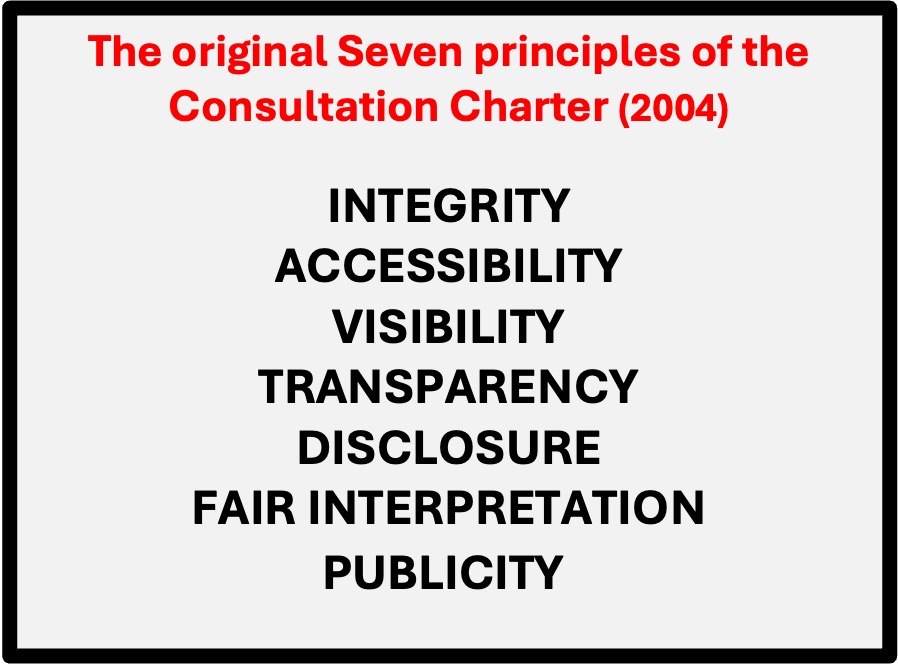
In my days at the Consultation Institute, we promoted a Charter of seven principles that formed the basis of many successful training courses, and there have been recent attempts to improve upon them, notably by colleagues in the Centre for Consultation
But none of these amount to a formal mechanism of governance. There is a fear that one merely adds a further level of complexity to a process that is already burdensome enough. At a time when politicians are on the warpath looking for excessive bureaucracy, who wants to encumber public engagement staff with layers of management and armies of officials checking your work?
HOwever, consultation governance is essential – and we need to keep it simple. There are many ways to assure it, but in my view there are three fundamental requirements.
Your governance arrangements needs to fulfil three roles and act as:
- The Holder of Accountability
Your governance is the ultimate statement of who is in overall charge. This is easier said than done as many consultations are initiated by more than one organisation. When the consultation on young people’s access to social media finally comes, we expect it to be jointly run by the Department of Education and the Secretary of State for Technology. Nothing inherently wrong in this but, for transparency, there needs to be clarity as to accountability.
It is said that success has many parents, but failure is usually an orphan. But knowing who is ultimately responsible is less about allocating praise or blame. It is more about understanding where authority lies and where it fits into the wider context. The truth is that many stakeholders doubt the true purpose and integrity of a proposed consultation – and without knowing who ‘owns’ the exercise, it is hard to exert influence. How often do we find that ambitious consultations are launched without ever having the knowledge or resources to be effective? In situations like this, true responsibility can be difficult to ascertain. Good governance should remove any doubts.
- The Custodian of the Mandate
Every consultation should have a clear statement of its purpose. Back in 2004, Elizabeth Gammell and I developed a Consultation Mandate as a succinct description containing a small number of key elements. Many practitioners still use it. It required consultors to identify themselves and the stakeholders whose views they sought. It expressed in simple terms the precise scope of the exercise, who would act upon the output, over what timescale, and what it was intended to accomplish.
Good governance requires this to be published – and implemented. Unpredictable events happen during the course of dialogue and there is often pressure to deviate from the mandate; mission creep is a frequent issue, and sometimes for good reason. What is important is that someone (or some Body) is there to safeguard the original intention and to be the only arbiter on whether it should be changed.
My recently published FOUR FUNCTIONS FRAMEWORK will help us move on to more function-specific mandates and I hope to work with colleagues and clients to develop useful tools for more agile consultation in 2026.
- The Guarantor of Standards
No matter how well specified, well-funded or supported a consultation may be, it still needs to conform to standards. Trouble is, there are no universal benchmarks of best practice that apply across enough of the many dialogue methods in current use. The exception is a Citizens Assembly and its derivatives, where excellent standards are evolving. In practice, however, many consultors choose their own standards and the best will announce them – mostly to persuade consultees of their bona fides.
Standards matter. It makes a difference if the consultation is accessible to all key stakeholders, documentation provided is sufficiently comprehensible or if the respondent profile is adequate. Questionnaire design must be above a minimum standard. And the conduct of public events must conform to identified expectations. As AI becomes adopted in many aspects of the consultation process, data standards have become a big issue in their own right.
But who is there to ensure that those standards are observed? Good governance pinpoints who exactly underwrites those standards. They must have the authority to commission and/or deliver to the required quality.
IN SUMMARY
Whether this supervisory structure is called a Project Board, a Consultation Steering Group, a Dialogue Oversight Committee or whatever matters less. Neither is the debate about having a small, tight, authoritative membership or a much larger body representative of relevant interests. There can also be an interesting discussion as to whether a single governance structure can apply to a whole programme of public engagement and consultation, and another on whether stakeholders and consultees should be included.
What matters most is that the three fundamental roles are adequately fulfilled.
I invite practitioners to examine their current arrangements, consider the extent to which these meet the requirements and maybe move to develop and apply more robust governance models for the future.
Rhion H Jones LL.B
February 2026
For more like this, and to receive the monthly Consultation Catch-up, click here
Leave a Comment
I hope you enjoyed this post. If you would like to, please leave a comment below.