This is Blog no 144
The UK Government is having a serious re-think about public engagement and consultation – especially in relation to important policy-making.
Some of what it suggests is perfectly sensible; other proposals such as repealing hundreds of statutory duties to consult may prove less so.
But there is widespread support for its desire (per “Rewiring the State”) to “replace the current model of consultation by default with new and modern forms of public participation.”
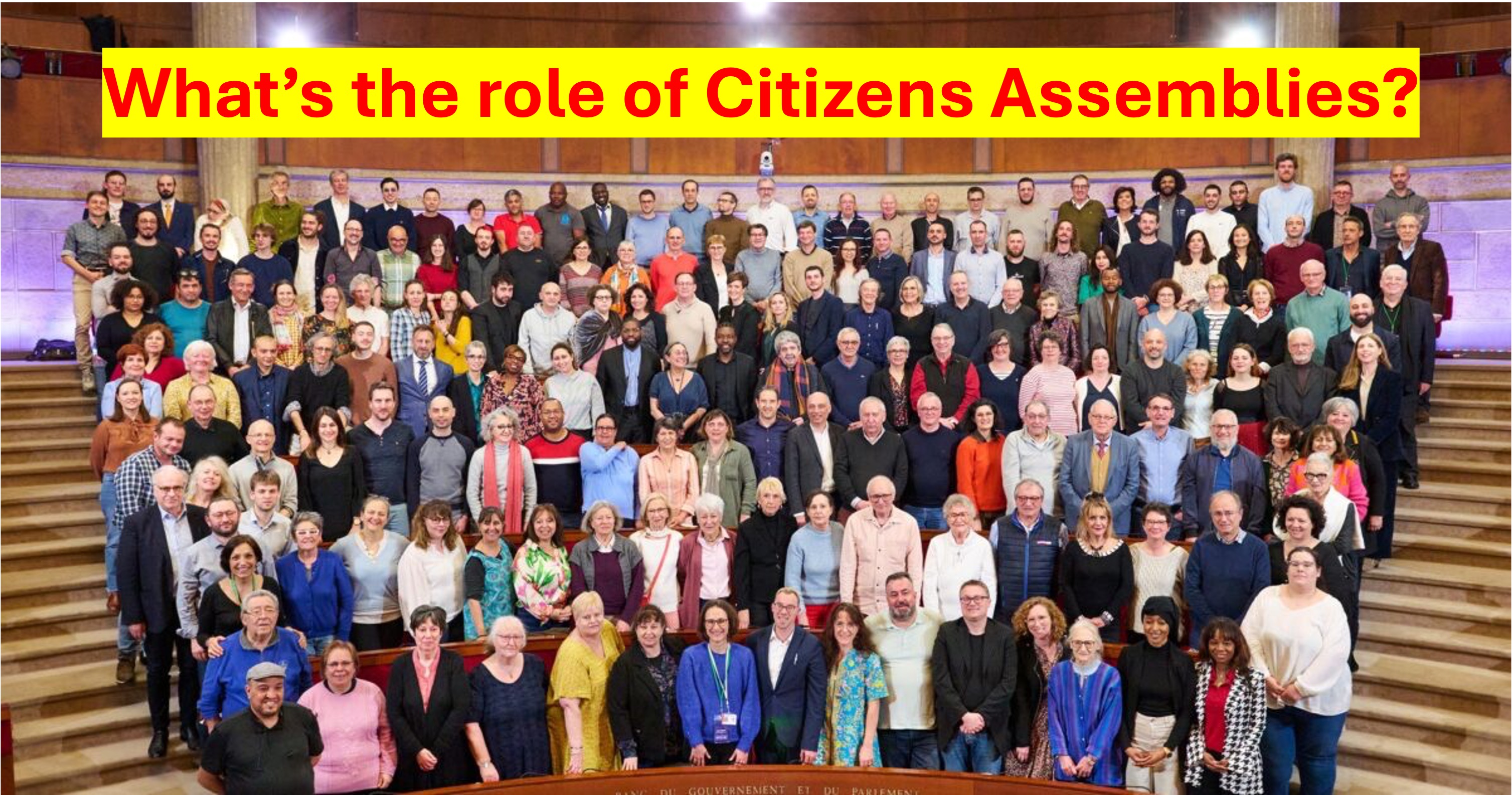
Among the methods it may have in mind are Citizens Assemblies of various kinds. If so, it climbs aboard an increasingly impressive worldwide movement towards more participative politics advocated by academics and practitioners of many political persuasions and none. They are undoubtedly a successful innovation with many thousands of committed supporters. The Green movement especially has bought into the concept, and Climate Assemblies have been held in over 20 countries.
But what impact are they having?
A recent study led by German researcher, Janosch Pfeffer and others is entitled “Citizens’ assemblies propose ambitious climate policy but impacts remain limited”. His team analysed 488 recommendations from six climate assemblies in Austria, Berlin, France, Germany, Scotland and the UK. They then compared each recommendation with existing government policy and considered whether the policy decision would have happened anyway - without the assembly?
They concluded that sortition-based Assemblies were consistently more ambitious than their governments, and many recommendations went well beyond existing public policy. They provided great in-depth consideration of important issues and enabled participants to dig beneath headline arguments and challenge the massive amount of disinformation that contaminates the public dialogue in many countries.
Laurence Tubiana, President of the European Climate Foundation points to a review of 300 studies finding that misleading information is undermining public trust and delaying climate action. Large-scale deliberative events, he says, “allows people to challenge the evidence and hear how the same policy might affect someone whose circumstances are very different from their own.”
These are the perfect conditions for informed debate – something that the online information environment rarely provides.
Beyond this, however, the study struggles to find evidence that Governments have acted upon Assembly recommendations. Only in France was there significant political buy-in, and this begs the question of whether these events carry enough clout to have the influence their organisers desire. Are they, possibly viewed by Governments as merely a sophisticated form of special interest lobbying?
Cue a second recent Report – from the University of Exeter and about The Politicisation of Deliberative Mini-Publics. It looks at a wider range of deliberative processes and the benefits and risks of their ‘politicisation’. In particular, it notes how many practitioners reasonably want to insulate such processes from contamination from ‘normal politics’. The argument is that they can by-pass institutional inaction. On the other hand, this often undermines their legitimacy and just makes it less likely that their recommendations will be implemented.
The Exeter academics refer to the distinction between these ‘Mini-publics’ and the wider ‘Maxi-publics’. And one of their suggestions therefore is “integrating mini-publics within the normal workings of representative institutions rather than relying on these as ad hoc experiments.” In part this is because the agenda and framing of the issues for discussion are normally set by the authorities who organise them. Is it better for Parliaments or local authorities to initiate them?
So – in summary, we have a global phenomenon with amazing potential to mobilise and motivate millions of citizens. But no-one quite knows where it fits.
So let me make a modest attempt:
- Citizens Assemblies can take many forms and need to sit in many different political systems – but for those of us who believe in representative democracy, they need to support it – and not undermine it.
- Although they can occasionally be given decision-making powers, they are mostly high-quality consultative processes leveraging objective information processing by representative individuals or groups using sound deliberative methodologies.
- Following the FOUR FUNCTIONS FRAMEWORK, they are best used for NAVIGATION (eg where do we want to go? what are our goals etc?) and EXPLORATION (eg what are viable options? what are the various actions we should take?)
- To improve the chances of Assembly findings being implemented, and notwithstanding the validity of sortition and other methods, those recommendations need to be subject to wider public and political debate, often through a formal consultation where all stakeholders have the opportunity to participate.
One of the persistent (and largely valid) criticisms of consultation has been its tendency to be a forum for an exclusive elite that knows how to access the system. Whilst this was partly true when consultations were paper-exercises based on dense detailed documents, the growth of more participative methods made them far more open and available for all relevant views to be expressed. The sheer number of contributions and the range of opinions expressed in recent high-profile UK consultations is testimony to their power to attract a wide audience.
Therefore, when Ministers talk about fewer consultations and replacing them with ‘more modern forms of public participation’, is there not a danger that it might reduce - not increase the number of people actually able to express their views and impact the perceived legitimacy of their conclusions?
We want the best of both worlds.
We want the maturity of deliberation that Assemblies and their derivatives provide.
But we also want wider society to acknowledge the representativeness of those who assembled.
That’s not possible just by lecturing us on the mathematics of sortition.
We also need to demonstrate that ALL stakeholder views can be heard and considered, even if the Assembly has co-produced the most persuasive proposals imaginable.
The sad truth is that everybody can’t decide everything and that accountability is knowing who ultimately takes responsibility for difficult trade-offs.
One of the advantages of consultation is that it is usually crystal clear who takes a decision and the opinions they have heard before they took it.
The advent of superior and more representative methods of gathering and presenting those views – such as Citizens Assemblies – is not a guarantee of better decision-making but can make a massive difference to the public discourse.
Rhion H Jones LL.B
The Consultation GuRU
Leave a Comment
I hope you enjoyed this post. If you would like to, please leave a comment below.