This is Blog no 145
Like many of the UK’s respected professional bodies, the Institute of Civil Engineers (ICE) has often considered the wider world where its members work. No doubt the ICE is well aware of the intense debate about the need to accelerate the renewal and enhancement of our nation’s infrastructure.
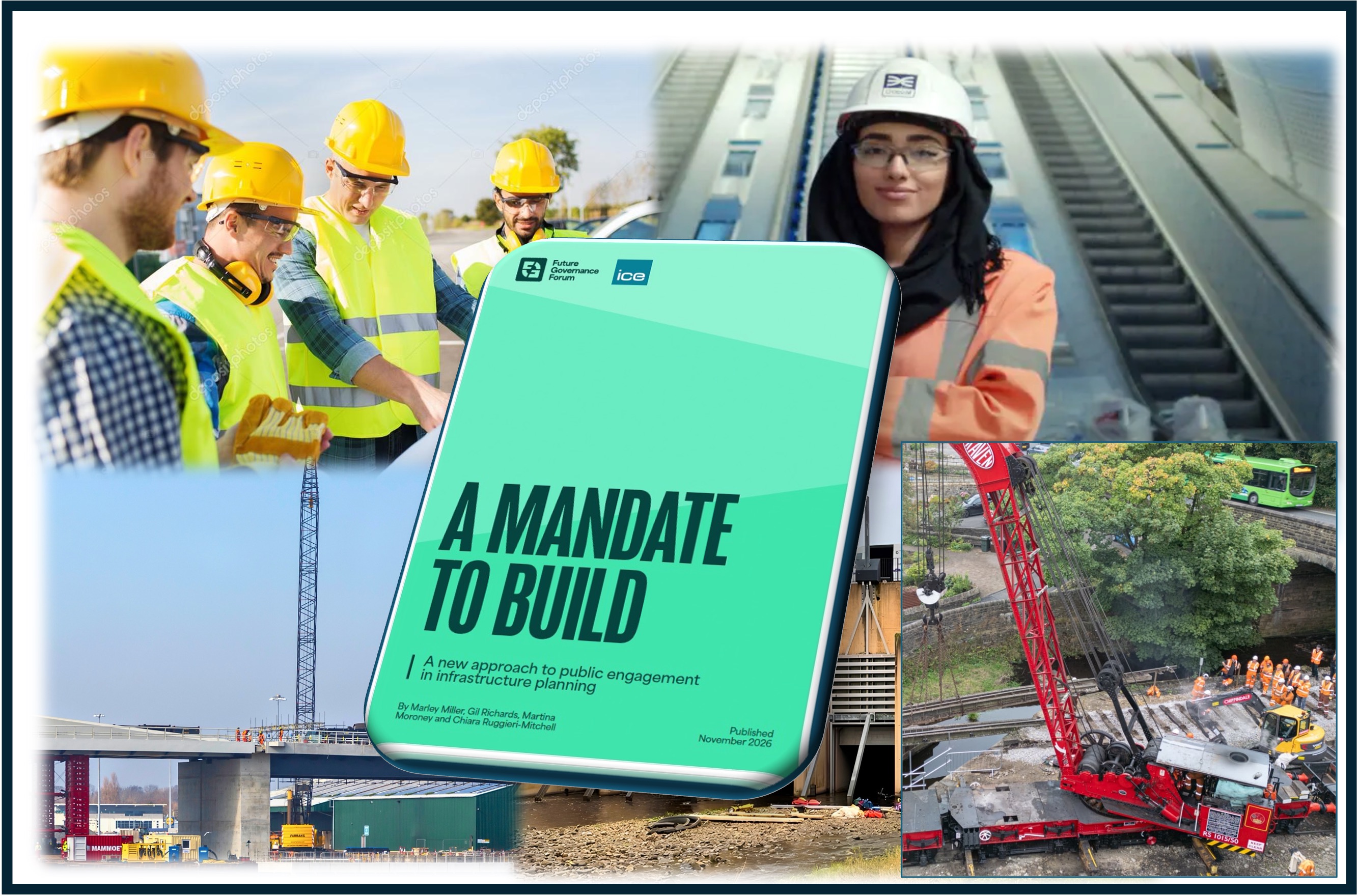
The opening words of its excellent new report, A Mandate to Build – written with the Future Governance Forum, could not put it better.
“Whether the UK can deliver the infrastructure it needs over the coming decade will depend on more than funding, engineering expertise or political commitment. It will require public trust.”
The ICE published an excellent set of eight Principles for Community Engagement with Engineering in 2022. All perfectly sensible and constituting best practice in the world of large-scale construction and engineering projects. Where the latest Report breaks new ground is in putting the principle of ‘social licence to operate’ front and centre of its thinking. It recognises that building against the will of unhappy communities will always add to costs and cause delays. And it sees the need to minimise such situations.
This is doubly welcome at a time when many politicians are having second thoughts about public consultation. They have been irritated by what they regard as slow, ‘gold plated’ bureaucratic engagement processes and unjustified judicial reviews. And they have been persuaded that the solution is to reduce the number and extent of consultations. The ICE – grounded in a more pragmatic approach – has chosen NOT to follow suit.
Instead, it has spotted the weaknesses of the current planning processes. The fact that despite the 2008 Planning Act providing for consultation on all-important National Policy Statements, few of them engaged a wide enough range of stakeholders.
The Report comments that:
Consultation on National Policy Statements takes place, but it is technical. Its respondents are mainly developers, statutory bodies and national organisations, and its conclusions do not reach communities in any form they would recognise.”
The problem has been clear. People seldom become interested in investments at nationwide level – until something appeared on a more local agenda. The ICE sees the answer as being to focus much community consultation at REGIONAL level – perfectly in synch with the recent Rewiring the State paper and the Burnham Government’s commitment to Mayoral Strategic Authorities. This is where dialogue now need to focus.
That is because much infrastructure (but not all!) does in fact lend itself to a choice of site/location. Nothing infuriates communities more than to be consulted on a fait accompli where the site has already been predetermined behind closed doors to which they had no access. The ICE’s research shows that people are more likely to accept siting decisions if they think the process is transparent and fair:
“whether decisions about where it goes and how it is delivered have been taken by someone accountable to the area.” (my emphasis)
They are on to something here. The Burnham doctrine of devolution stands in contrast to the Sunak and Starmer instinct to persevere with centralised decision-making and reduced consultation – which they justify because there is less to engage upon, and it just slows things down.
At project level, the Report sees the priority being to engage more constructively on design, construction, mitigations and community benefits. The acrimonious nature of so much adversarial dialogue has in the past made these latter-stage conversations more challenging – and not helped by the frequency with which the participants change. The industry has inherited a practice for entirely different engagement consultancies to work on the years-long consenting process and for new agencies to continue the dialogues once shovels are in the ground. No matter how proficient, they often lack the deep knowledge of local communities, their priority concerns and anxieties. (I’ve heard the arguments about the benefits of new faces, but I have not been convinced!)
For those in the infrastructure business, there is much in this Report that rewards study. In particular, when asked what makes project communications credible, 73% of the ICE respondents said, “what local people would get in return”. 69% wanted developers to “set out the downsides as well as the benefits.” 64% wanted to hear “what would happen if costs rose or things went wrong.” We still have situations where PR-instincts have too much influence and over-sell projects that engineers know full well can cause difficulty and distress.
Without any collusion, I find it reassuring that A Mandate to Build mirrors so closely the FOUR FUNCTIONS FRAMEWORK I have offered as a better way to approach public consultation. Fundamentally, we need to switch the emphasis from the FORM that consultation takes to the FUNCTION we are trying to fulfil, and I think the ICE’s proposals seem much alike
- At National level, it suggests a Citizens Panel at the start of every 10-year Strategy refresh. Very much my thoughts on the NAVIGATION (Where are we going? What are we trying to do?)
- At Regional levels, it foresees Spatial Development Strategies enabling options to assess deliverability and public acceptance. Precisely what we need for the EXPLORATION function
- Individual Projects still need a Go/No Go decision-point, and the ICE suggests an independent liaison chair to acknowledge how difficult these choices can be. It follows my DETERMINATION
- Host Community levels will major on community benefits and include an annual report on how they are ensuring that host communities gain! This is close to my concept of the IMPLEMENTATION consultation function and is possibly the area where most innovative thinking is still needed.
Maybe the most heartening development of all is to see professional industry bodies taking a greater interest in the wider societal forces that affect their ability to add value. We are told that we have some of the finest engineers in the Western World, that our Universities have the most prestigious innovations and that consulting engineers from the UK build some of the world’s most ambitious projects. It’s good therefore to see a genuine attempt to resolve the issues that prevent us from exploiting our own talents fully on home soil.
Maybe the most heartening development of all is to see professional industry bodies taking a greater interest in the wider societal forces that affect their ability to add value. We are told that we have some of the finest engineers in the Western World, that our Universities have the most prestigious innovations and that consulting engineers from the UK build some of the world’s most ambitious projects. It’s good therefore to see a genuine attempt to resolve the issues that prevent us from exploiting our own talents fully on home soil.
One Report is not enough. I hope we can now persuade the ICE and its supporters to invest in sufficient training and education as will help grow a new generation of civil engineers that understand the importance of public engagement and can work with colleagues to deliver more meaningful consultation and dialogue.
Rhion H Jones LL.B
November 2026
Leave a Comment
I hope you enjoyed this post. If you would like to, please leave a comment below.